Reshaping Entertainment Majors is Underway
Content Insider #949 – Bundle Up
By Andy Marken – andy@markencom.com

“We can’t change what it is, so we keep it light until it’s time to get dark. And then we get pitch black.” Barney Ross, “Expendables 2,” Lionsgate, 2012
The other evening, we walked into the family room and asked our daughter (who was sprawled out on the couch) what she was doing.
She looked up from her iPhone and said, “Duuhh watching TV.”
Yeah, she’s at that smart age.
But the TV screen was dark.
To Gen Zs, any video – YouTube/TikTok clips, movies, shows is TV regardless of the screen they’re
staring at – big TV, computer/tablet or smartphone.
Only Wall Street and people who track the fate of the 200+ payTV channels, the rapid rise/spread of streaming services and the ubiquitous presence of social media videos try to differentiate.
Ordinary folks don’t care, video on the screen is TV.
Those who shaved/cut their pay TV bundle to have the economic “freedom” of streaming anytime, anywhere, any screen has grown rapidly.
Folks in the Americas have their choice of 348 services including the big six – Netflix, Disney+, Amazon Prime, Paramount/Skylark, Comcast’s Peahen, Apple TV + – while there are over 600 local and regional streamers elsewhere in the world.
In the US, arguably the most expensive streaming market, 46 percent of households have an average of four streaming subscriptions, spending about $70/mo. and complaining about the cost even though they were paying $98+/mo. with their payTV bundles.
It’s not the cost.
It’s their time investment in finding something to watch going from service to service to … and end up settling!

The 20 minutes of ads were a “tolerated” pain … the value of 200 channels no one ever watched felt like a huge waste of money but gawd, they missed the easy move from channel to channel, show to show.
Streaming at $6-$15per service was like cheap … almost free.

Folks couldn’t wait to rip the door off the bundle and pick the inexpensive services they wanted to watch–the shows/movies/stuff they wanted over their wired/wireless broadband pipes.
Market.us Scoop estimates that there are 1.1B streamers this year or about 45 percent of the total TV viewing.
The average global streaming subscriber has four streaming services and spends about 3.7 hours a day watching video content with mobile viewing accounting for about 35 percent of folks watching stuff.
More/Less – The number of newer, better, different streaming video services is slowing but the number of subscribers continues to grow as we enter the period of consumer-selected survivors.
Despite the fact that linear TV is still subscribed to by more than 1.8B households, streaming subscriptions continue to grow … rapidly.
But it is far from a single streaming video market.
Although not the first streaming video service, Netflix jump-started the cutting/shaving of the cable TV bundle and the shift to streaming entertainment about 18 years ago.
Since then, it has become the definition/standard of the streaming video industry in 190 countries sans North Korea (locked door), Syria/Crimea/Russia (although folks reportedly have found ways around the blockades) and China’s great digital wall.
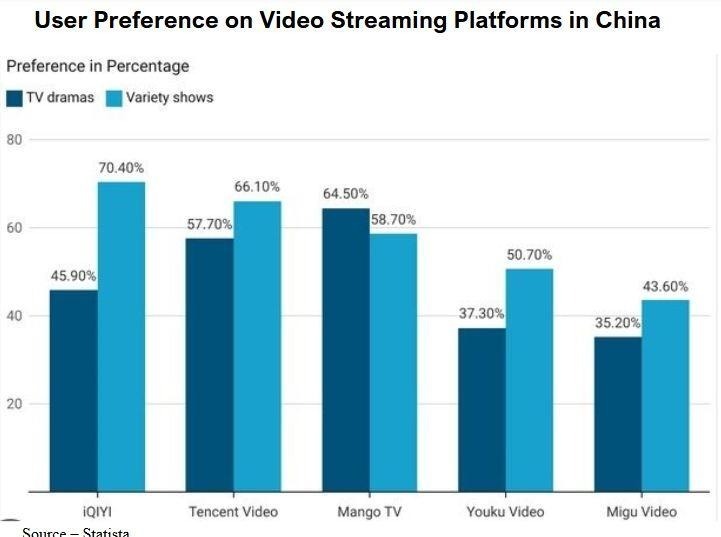
Gated Community – While China carefully filters what content is allowed in the country, local creatives have significantly improved the quantity and quality of content developed in the middle kingdom and the exchange of video stories is gradually increasing.
The Chinese market is projected to reach close to $25B this year, growing to nearly $35B by 2030 with more than 550.3M users.
The Middle Kingdom is second only to the US in streaming video users and is projected to experience a 22 percent increase over the next five years.
While the average user pays about $52/mo., China’s market is evolving rapidly as people demand more diverse content (beyond “country inspired” storylines) and they are insisting on a more enhanced viewing and e-commerce experience.
With a population of more than 1.5B people and a growing middle-class, consumers could see a rapid shift in content variety. With the rapid expansion of 4G/5G networks, mobile video vs home set consumption is increasing dramatically.
With over 1.4 billion people and a burgeoning middle class, China presents one of the most lucrative opportunities for video platforms and advertisers. Mobile video consumption in particular has seen a sharp rise. A staggering number of Chinese mobile internet users are consuming video on the go, thanks to the rapid expansion of 4G and 5G networks. As a result, mobile-first video platforms in China are now a dominant force, offering personalized, on-the-go video experiences.
Tencent, iQIYI, Mango and Youku have added extensive video content partnerships into their e-commerce, online shopping business models.
In addition, they are making strong moves to expand their streaming services to other countries across SEA.
Unfortunately, unless people use a VPN, outside services’ content is still not available to local consumers.
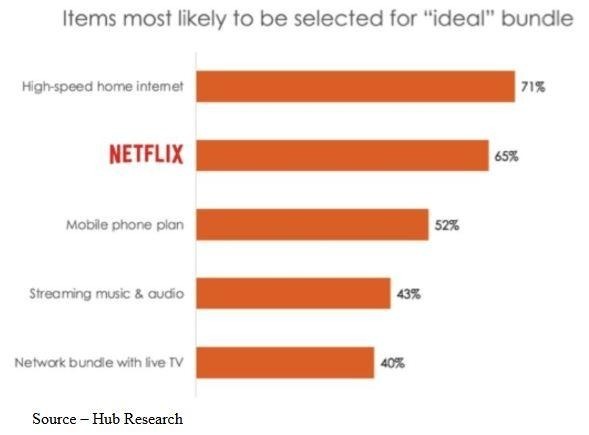
Defacto First – For many people around the world, streaming video is synonymous with Netflix and a solid internet connection. Service providers are expanding their offerings to meet consumer demands.
But even for the Chinese market, Netflix being first out of the streaming was – and still is – the first streaming video service people signed up for, often still hanging onto their cable bundle out of habit or … just in case.
But they laid down the ground rules (good/bad) for home/personal movie/show viewing which studios/networks quickly copied in their rush to have a direct connection with the customer.
While in the early days Netflix didn’t have its own original content, it.
licensed the old stuff lying around in studio libraries. You hook folks by being “inexpensive.”
Now only an idiot thinks you can invest $10-15+B a year as we do today for content and have a profitable business by charging folks only $15/mo. for all you can watch video stories.
But viewers didn’t/don’t care if streamers are profitable … they came to be entertained!
You don’t dole out a series one week at a time, you dump it all into the library so people can binge all weekend long and never move from in front of the screen.
Studios quickly realized their libraries were really valuable, so they forgot about licensing and pulled back their libraries and Netflix ventured down the content creation route, developing creator and studio relationships around the world.
While it irked theater owners and put studios in an awkward position – which has since sorta, kinda been worked out – people liked the idea of new theatrical movies first on their home screen.
For the most part, Netflix has remained true to its focus of being in the subscription/entertainment business and appealing to a very large segment of consumers/fans, even though Amazon Prime and Apple TV have found value in limited theatrical release.
Theater-first enables them to recover “a little” of their content investment, use moviegoer/reviewer WOM as marketing and yes, make some projects eligible for little gold statues.
Today, Netflix has a library of about 2000B hours of content available to stream or enough for the average guy/gal to watch for 286,000 lifetimes.
Interestingly, while people sign up for and turn to the streamer first to watch “what’s new,” subscribers increasingly spend most of their time with the movies and shows of yesterday.
Think about it.
How often have you read about a movie or series that was made/died years ago but has been suddenly “rediscovered” and is producing record viewing hours?
A lot!
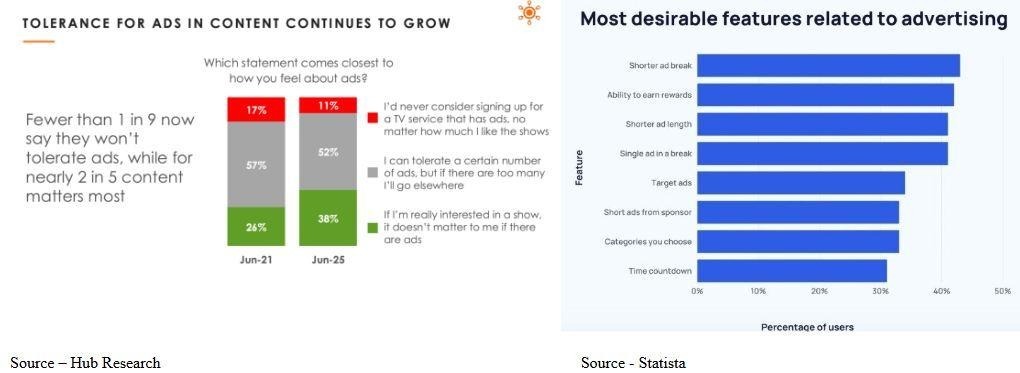
Selective Trade-offs – Consumers are willing to have “a few” streamed to them if the services lower the monthly charge; but they will not go back to yesterday’s payTV barrage. In addition, they are now looking for more information and assistance from the tailored ads they view.
The one rule Netflix broke itself of early on was the “no ads … ever” rule because most people are willing to trade a few minutes of ads an hour for a lower cost.
Yes, we have a few ad-intolerant (like lactose intolerant) friends who go with the flow.
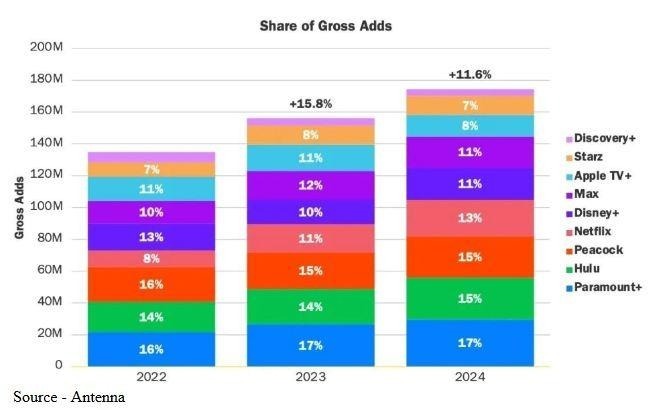
Hi/Bye – Streaming service providers have to listen and respond to with content, services and pricing that are more closely in tune with the consumers’ wants/needs, not activities that are focused on their own goals. Or, they need to bundle their content with people who will listen and respond.
And it’s an issue that faces every streaming service equally.
Last quarter, Antenna reported that streaming services signed up 45.3M subscribers while losing 43.3M for a net addition of 1.9M.
So now you might have an understanding why Disney quickly followed Netflix in no longer reporting their total global subscribers and instead focusing on income and profit to keep Wall Street from grabbing the Pepto following every earnings report.
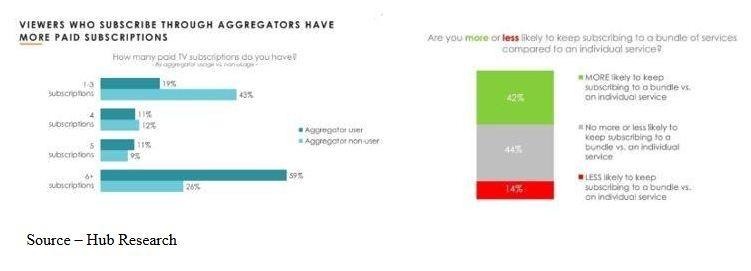
Bundled Answer – The availability of excellent video content from all of the services along with the associated costs is becoming more of an irritation to consumers as they pay for all of their services and still can’t find what they want to watch. People don’t care about the services; they care about their content and their budget.
The easiest solution to the churn problem is to reach back in history to the cable days and offer folks “value-packed” bundles.
Broadband providers – Comcast (Xfinity), Spectrum, Sky, AT&T, Verizon, BT, Tata, NTT, Orange and others – that continue to offer cable TV bundles are also selling streaming bundles.
In the US, Comcast sells one with Netflix, Peahen (peacock), Apple TV+ while service providers in other countries have assembled discount priced bundles and are working to expand their entertainment offerings.

While the major studios are willing to entertain similar service provider discussions, they are also developing/assembling their own “gotta have” offering.
In fact, it has been speculated that if you signed up for a Peacock/Paramount+/Max bundle, you’d be less likely to cancel.
But still, studios are most interested in keeping “their” subscribers to themselves to benefit their balance sheets.
Disney brought together Disney+/Hulu/ESPN and its majority ownership in Fubo then sweetened the package by offering the NFL minority ownership in ESPN, added long term agreements with LaLiga, UEFA Women’s League, MLB, NHL, WNBA, NWSL and other international sports.
Priced at just $17/mo. (with ads) it makes it easy to sign up for and tough to leave, especially if you’re a sports fan.
Oh yes, Bob Iger also agreed to offer a third bundle with Max priced at $17/mo. (with ads) but…
,
David Zaslav has had a tough time since he rolled into LA in his Rolls Royce convertible ready to reshape WBD and Hollywood.
Turning the debt-laden content creation, distribution, news/sports giant proved to be more difficult than the experienced reality TV executive originally thought.
He started by slashing costs/staff everywhere and reigned in budgets, putting the firm’s traditional linear business in defense mode to pay down $19B of the company’s $40B debt.
Despite owning what he calls the largest TV library in the world and being a major player in the TV/movie creation industry, the best move was to divide off the linear TV business and put Gunnar Wiedenfels in charge.
Zaslav assumed control of the HBO Max streaming business and studio operations which has had a number of expensive but highly successful films this past year.
With modest success in the Americas, Zaslav has said the organization is focusing on becoming a true global streaming service with a number of key distribution agreements already signed in Europe, Australia and Turkey with others “in the wings.”
Focus may help.

But the biggest shakeup, reshaping in the industry, has finally taken place with David Ellison finally taking control of the new Paramount-Skylark.
One of his first moves was to put to bed rumors regarding the spinning off of its linear TV service – CBS,MTV, VH1, Nickelodeon, Comedy Central and the UK’s Channel 5 but rather redefine and refocus their activities for the long term, including what he called the Taylor Sheridan middle-audience marketplace.
With his solid grounding in both content creation investment and technology, one of the first changes that will be made is to move Paramount+, Pluto TV, BET+ to a common underlying platform to make all of them more effective and efficient.
And yes, it will enable them to access user data across the platforms to provide better recommendation to subscribers as well as provide content creators with more intelligent and meaningful development/production guidelines/assistance.
The first media company head with strong tech ties, he said Paramount will embrace AI as a tool for creators not for mediocrity.
You can expect the Millennial to also take advantage of his father’s (Larry Ellison) Oracle-leading cloud service and long-time partnerships with Apple and Meta.
Of course, if Ellison senior takes control of TikTok’s stateside business as is rumored, it would deliver a world of social media/content distribution cross fertilization almost unavailable to the competitive studio/broadcast organizations.
But of greatest importance to the filmmaker/talent crowd is his grasp of and commitment to the theatrical movie market which is best illustrated when he rescued the over budget World War Z disaster.
He invested millions in rewrites/reshoots and turned the doomed project into a summer blockbuster.
Even with a more than healthy financial war chest, Ellison has noted that cuts will be made but he emphasized that they will be done with in-depth deliberation and will be done once rather than a continuing series of nips and tucks.
To show he is building for the future, he announced the addition of UFC boxing to spark up the organization’s core portfolio of golf, NFL and March Madness with a promise of more carefully selected sports content to be added for linear and streaming services.
Focused on reestablishing the Paramount brand and remaking a number of market segments, there are already rumors the organization is “looking closely” at the weakened/demoralized entire pre-split WBD.
He has already proven he has the patience and professionalism to deal with governmental scrutiny and there are probably a lot of midlevel and creative people who would find it a welcome change … including Wall Street.

Streaming didn’t kill any form of personal/family entertainment.
The big four streamers are already in tune with consumers’ changing tastes as well as the creators’ focus on telling new, different and more immersive video stories.
It will be interesting if other streamers realign their goals and budgets to focus on creative projects that can fill the voids.
As Booker said in Expendables 2, “Sometimes, it’s fun to run with the pack.”
Andy Marken – andy@markencom.com – is an author of more than 1000 articles on management, marketing, communications, industry trends in media & entertainment, consumer electronics and software and applications. He is an internationally recognized marketing/communications consultant with a broad range of technical and industry expertise, especially in storage, storage management and film/video production fields. He also has an extended range of relationships with business, industry trade press, online media and industry analysts/consultants.