Analog Way Announces New Aquilon Firmware 6.2 Featuring Native Stereoscopic 3D Support, Instant Content Failover and Many Operational Enhancements
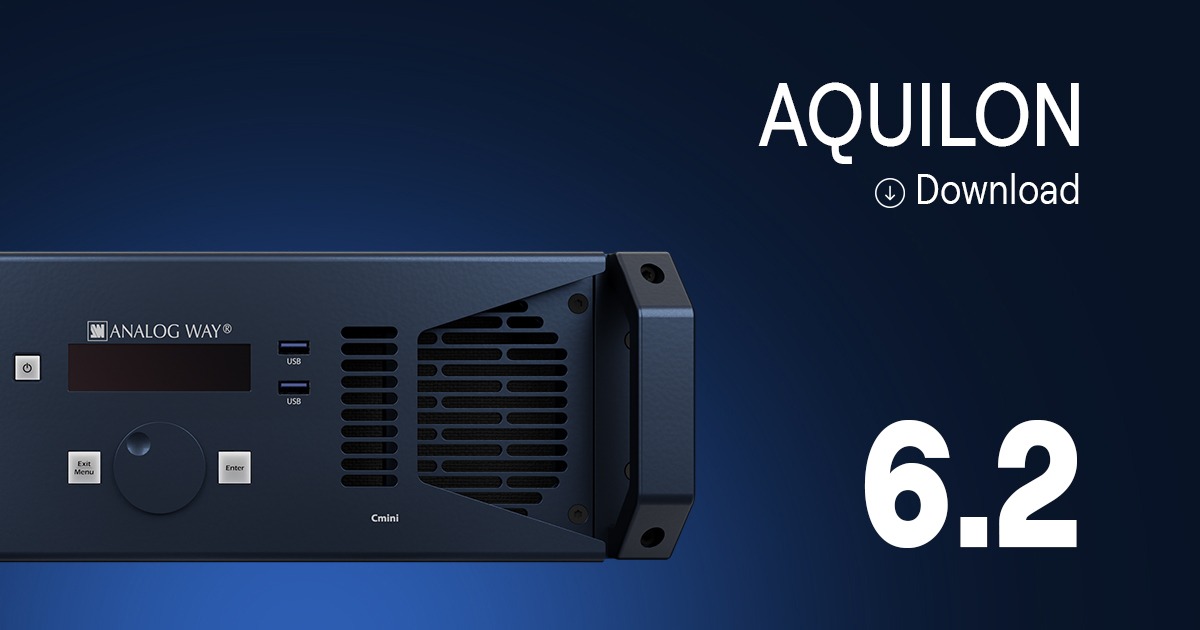
Analog Way has unveiled a new firmware release for its Aquilon screen management systems which addresses next-generation immersive stereoscopic 3D visualization applications, market demands for ever-larger canvases and higher resolutions, the necessity for content continuity in high-profile environments, and increased expectations for intuitive control software with greater operational efficiency.
The Aquilon Firmware 6.2 release offers many advantages to customers across all market segments. Chief among them is native stereoscopic 3D support up to UHD 60 Hz per eye, enabling seamless mixing of 2D and 3D content with uncompromised image quality in large-scale immersive environments.
It also enhances operational resilience and ensures show continuity with Backup Groups for instant content failover, simultaneously switching inputs and background sets to their backup sources.
Aquilon Firmware 6.2 also expands format flexibility. Optimized for large-canvas deployment, it reduces infrastructure requirements through support for ultra-wide formats, 8K resolutions and custom timings. Faster and more intuitive software tools and streamlined workflows mean improved operator efficiency with enhanced Web RCS usability, streamlined controls and productivity-focused tools. Additionally, reliability and stability improvements offer faster, more confident operation in mission-critical applications.
Specifically, Aquilon Firmware 6.2 provides:
Stereoscopic 3D support

Delivering high-quality stereoscopic content is technically demanding, requiring substantial bandwidth and processing power. As a result, many systems are limited to reduced resolutions or lower refresh rates, compromising the viewing experience.
Aquilon removes these limitations with native stereoscopic 3D support, delivering formats up to UHD 60 Hz per eye as a standard capability. Using its DisplayPort 1.2/1.4 input and output cards (ACC-AQL-IN-DP and ACC-AQL-OUT-DP), Aquilon can ingest and output frame-sequential 3D signals with embedded synchronization at resolutions up to 3840 × 2160 at 120 Hz, 4:4:4, 8-bit. This provides exceptional image quality while maintaining the high frame rates required for comfortable and immersive stereoscopic 3D viewing.
Aquilon’s streamlined workflow also makes it possible to seamlessly combine 2D and 3D content within the same composition. Users can build large-scale canvases spanning up to 8 UHD outputs or 16 HD/DL outputs, enabling immersive environments without sacrificing flexibility.
When using active-shutter 3D glasses, the embedded synchronization signal can be phase-adjusted and routed through the Frame Lock Loop-Through connector, providing precise control of the glasses’ shutter timing and ensuring optimal viewer comfort.
Backup Groups for Instant redundancy for critical show content
Unexpected failures can happen during a live event requiring operators to restore content immediately, either by switching to a redundant media server or falling back to a predefined still image.
To address these scenarios, Aquilon now includes the Backup Groups feature, which allows users to create collections of input backups and background set backups that can be switched simultaneously with a single action. This enables fast and coordinated transitions to backup sources, ensuring continuity of the presentation. For maximum responsiveness, Backup Groups can be triggered either manually by the operator or automatically when a failure is detected on any member of the group.
The feature is available through the Web RCS, Aquilon’s web-based remote control interface, and can also be assigned to a dedicated custom key on the RC400T control console for immediate access during live operation.
Enhanced format management
In large-scale display systems, the number of outputs required to build a canvas can have a significant impact on overall project costs. This is particularly true for LED wall applications, in which reducing the number of LED processors often depends on the ability to create optimized custom formats and maximize the available signal bandwidth.
To provide greater flexibility and efficiency, Aquilon now includes a broader range of predefined formats for its DisplayPort 1.2/1.4 input and output cards (ACC-AQL-IN-DP and ACC-AQL-OUT-DP), including 8K at 30 Hz and a variety of ultra-wide resolutions commonly used in immersive and LED display environments.
In addition, the Custom Formats feature now supports VESA CVT Revision 2.0 Reduced Blanking calculations. By minimizing blanking intervals, Aquilon can maximize the effective active pixel count within a given bandwidth, enabling higher resolutions and more efficient signal transport without increasing infrastructure requirements.
Productivity and reliability
Configuring a show can be time-consuming, making workflow efficiency critical for operations. To streamline day-to-day operations, Aquilon’s Web RCS now supports basic mathematical expressions directly within numerical entry fields. Operators can perform calculations using standard operators (+, −, ×, /) without leaving the application, eliminating the need for external calculators and accelerating configuration tasks.
Enhanced screen layouts now offer more intuitive controls. Users can now maintain layer aspect ratios or resize layers symmetrically using familiar keyboard shortcuts while manipulating objects with the mouse, making layout creation faster and more precise.
As part of Analog Way’s ongoing commitment to improving the user experience, the Web RCS interface now provides greater consistency, clarity and readability. Enhancements include improved visibility of critical status indicators, such as Screen Fade Out activation, as well as a more logical organization of memory-related settings. The new firmware release also enhances the stability, reliability and robustness that operators expect from Aquilon in mission-critical environments.
Aquilon Firmware 6.2 is available now.