
Social Video Isn’t Entertainment…It’s FOMO
Content Insider #952 – Good ‘Nuff
By Andy Marken – andy@markencom.com

“I think we have to go all out. I think that this situation absolutely requires a really futile and stupid gesture be done on somebody’s part! – Otter, “Animal House,” Universal Pictures, 1978.
We just finished wading through five different reports on the state of the home/personal video content industry and it should come to you as no surprise that linear TV is dead and just doesn’t realize it.
“That” crowd is getting older, smaller. People don’t want to pay BIG bucks for 200+ channels when they only
want 2-3. No one really likes 20 min. of ads for 40 min. of show in an hour. Did we mention the viewers are old and their numbers are shrinking?

Jeezz, lay down so we can have the wake!
The only problem is that all of these vicious whispers, rumors and forecasts of the new, better entertainment are somewhat like Mark Twain’s quote back in 1897 following newspaper reports of his demise when he said, “The report of my death was an exaggeration.”
Actually, it took him 13 years (April 12, 1910) to die (in Redding CT if you’re curious).
That’s where we’re at with linear TV.
Linear TV (broadcast and cable) still has 97.5 percent of the global monthly viewership and slightly over 40 percent in the Americas according to highly respected research firms like Statista, Nielsen and Kantar.
Yes, it’s declining; but it remains high–especially among Baby Boomers and Silent Generation (old folks) in a number of countries around the globe that have an average viewership of over 2.5 hrs. daily.
Meanwhile, networks load up on inexpensive content like unscripted, game/contest and talk shows.
Sure, it has fallen a lot in the Americas (41min/day) as well as in Japan, China and other countries with aging populations–especially when it comes to news and sports.
That’s probably also why you see so many drug and lawyer ads (if you still have your big, beautiful bundle) because advertisers go where the customers are.
Across all entertainment distribution formats (linear, streaming), the average household watches 3 hrs., 13 min. of TV a day.
Even that time, according to industry analysts, is down 10 min/day, probably because the next wave of entertainment (creator short/long social video) is underway, especially with Gen Alphas/Zs who live on their smartphones.
At the end of last year, it was estimated that 74 percent of all mobile data traffic was video of anything, everything, everyone.
For them, it’s FOMO and they can’t wait to see more of the stuff, even if it’s half-baked.
People will have spent over 4T hours on social media platforms last year and over 60 percent of that time was spent watching videos – TikTok, YouTube Shorts, Instagram Reels, etc.
Cripes, even Ted Sarandos, Netflix co-CEO, noted last year that they were also watching their movies and shows on the small screens, citing his son’s watching Lawrence of Arabia – a 3h 47m film – on his smartphone.
Wow!
The entertainment industry is moving so fast that its old boss – Reed Hastings, founder/chairman of Netflix, once commented that the company’s greatest competition was sleep.
That’s probably true of “older” generations; but when it comes to Gen Zs and Millennials, short-form video swiping is consuming a lot of their time.
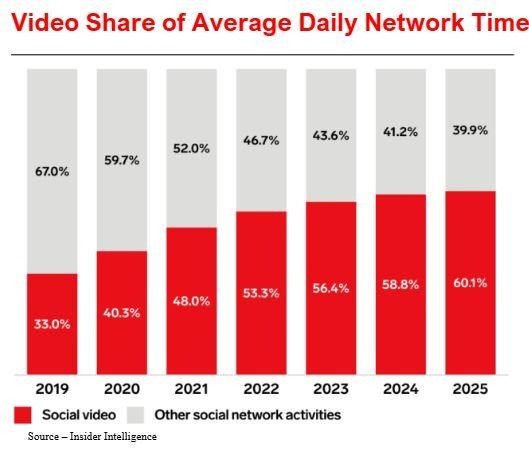
Hooked – Social media algorithms work just as perfectly as they’re designed, keeping digital generation folks hooked on just one more.
When it comes to content viewing, broadcast and streaming viewing was way behind their video hunger with 47 and 46 percent respectively.
We get it … we get it.
Gen Zs (56 percent) and Millennials (43 percent) find social media video content more important to them than movies/shows. They spend about 50 minutes a day watching “content” and only about 43 minutes a day watching a good/great movie or show.
All that really means is that the two video formats (social media video and streaming) serve two different purposes that are both cooperative and competitive and that both can help and damage the professional content creation industry.

Then, they use their smartphone where they can easily watch 80 videos in an hour.
And during that viewing hour, the very aggressive social media algorithms are at work keeping them involved to watch just one more, just one more and …
Yep, the algorithm knows what people are most likely going to want to watch before they do.
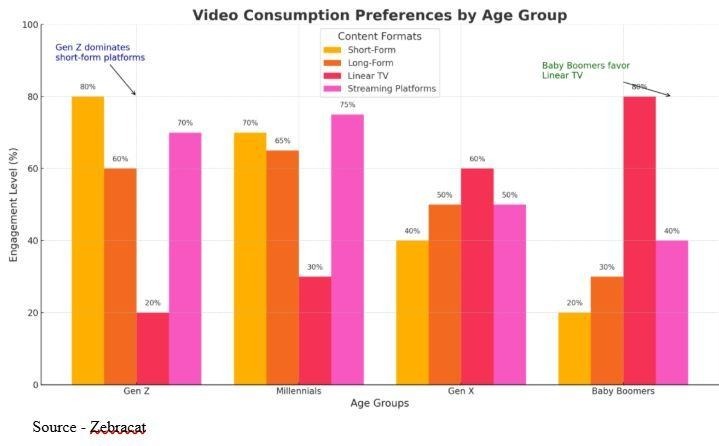
Churn – Perhaps the easy in/easy out subscription to streaming services has made it too easy for people to hop around the various services, binge on desired content, cancel and return … later.
While the churn is good when you’re on the winning side, services also know that at some point they will lose the subscriber.
It’s called churn and telcos have had to deal with it since the breakup of Ma Bell in 1982.
Reasonable or not, households have established a home entertainment budget.
When all of their subscription services exceeded the budget, the first thing they did was switch to ad-supported services, largely sticking with the mainstream services (Netflix, Disney and player or players to be named).
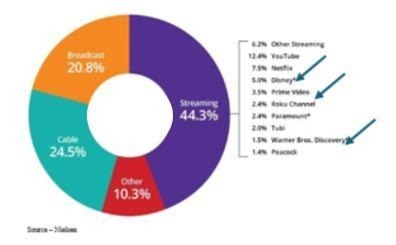
Close – Streaming hasn’t killed pay TV because it’s a long way from dead. In fact, the two entertainment sources are almost equal as pay TV works to find a way to be relevant to the viewers.
Today, streaming accounts for about 45 percent of the total TV viewing time in the Americas.
Households have cut back on the number of streaming services as they have come to realize that an infinite number of entertainment options are both frustrating and expensive (time/money), especially when you waste time finding something to watch and end up settling.
They realize that the streaming promise is meaningless — to watch whatever you want, whenever you want, wherever you want, however you want when you can find it.
Disney is able to draw on a deep and broad field of experience including amusement park attendee data around the globe to tap into current and future entertainment interests as well as an IP library in almost every sector.
All of the streaming services offer both ad-free and ad-supported subscriptions which has helped them reduce shrinkage (it’s not that much, the ads seem better and we do like some of the content) and it has assisted all of the services in increasing their subscription bases.
There’s a third category of streaming services that is often passed over – FAST (free ad-supported) which meets the entertainment needs of many households. For others, it’s a solid addition to their viewing with
thousands of great shows/movies they didn’t see the first time around or simply want to watch again.
Don’t kid yourself, there are plenty of great projects in their libraries with most of them produced in the past 10-15 years and they still maintain a low ad volume.
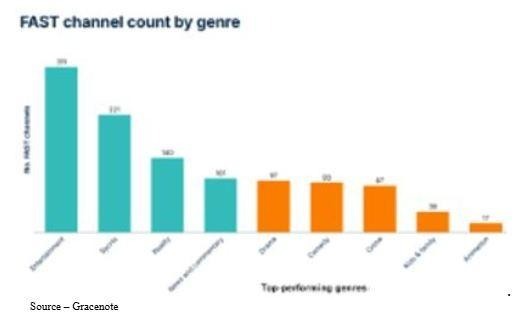
As for the FAST services, there are more than 197,000 TV shows/movies as well as live sports, concerts, events and local area stations.
Live sports, once the cornerstone of pay TV, are increasingly moving to subscription services because fanatical fans will follow their sports/teams.
Sports have significantly increased services CODB (cost of doing business) while attracting the audience varies by sport and country.
While bundled services are a short-term bandage for lesser but good streaming services to dampen the festering issue, consolidation will take place.
At the same time, there’s one very well-established social media service that is pushing to be a serious part of the personal/home entertainment equation … YouTube.
Founded a couple of years before Netflix, YouTube started out as a “broadcast yourself” ad-supported service and when Google purchased them a year after being founded for $1.65B, the service was delivering 100M videos a day to a worldwide audience of 72.1M.
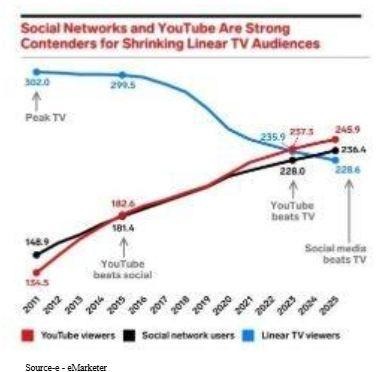
Tough Comparison – It’s true, YouTube viewing has expanded but it’s difficult to compare it to/against linear TV when one of the services is primarily linked to the household and the other is instantly available on any device, anywhere. But it is growing … rapidly.
Today, it has about 2.5B users and more than 500 hours of video are uploaded every minute. Globally, visitors watch 1B hours of content a day.
Over 60 percent of the views are on mobile devices internationally while in North America viewership on-+ TVs surpass mobile devices, especially with Gen Zers and Millennials.
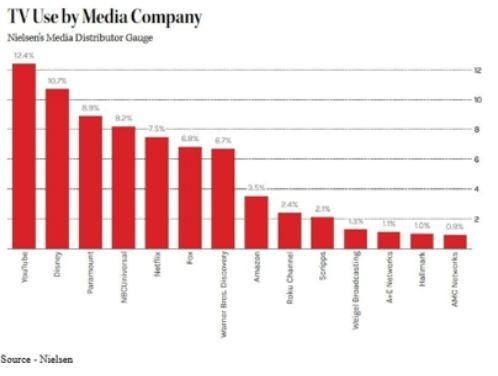
Home Sweet Home – When you don’t pay much for the content your users spend time watching on their TV you can be very profitable but for the most part people watch the content for different reasons and are less committed to the videos than they are with streaming movies/shows.
While YouTube has increased its investment in original programming and license movies, it is a minor percentage of the organization’s total content library.
The viewing habits are different from those of streaming service viewers who turn to the services to watch movies/shows.
YouTube viewers turn to the service for entertainment from their millions of content creators including a growing number of actors, athletes, musicians and comedians.
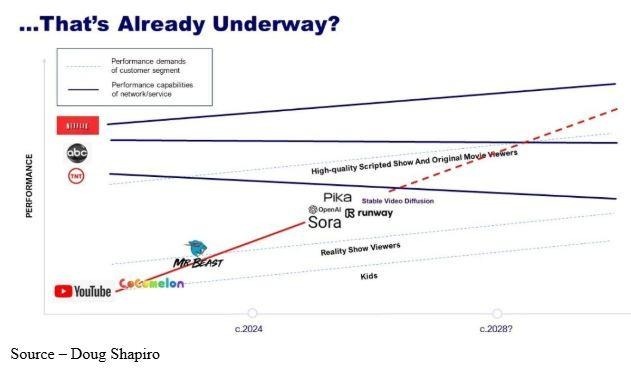
Creators Rise – A few social video creators have gained massive viewing/following numbers but not without a tremendous amount of work and commitment. But they have shown it’s a good way
for professionals to keep their faces, names and talent in front of movie/show executives.
While it requires a lot of time, focus and commitment for professionals to develop posts on YouTube, an
increasing number feel it is worth the effort because it gives them complete freedom to call all of the shots on
the content that is produced.
It also allows producers, directors, actors, camera handlers and postproduction people to show off their talent
which can lead to professional roles because it keeps them and their talents in front of studios as well as
consumer viewers around the world.
Don’t get us wrong, we’re not huge fans of YouTube but it is an excellent place for marketing products/services, significant assistance to a firm’s customer support efforts with how-tos and problem-solving videos. And for creators to show off their talents, ideas and work.
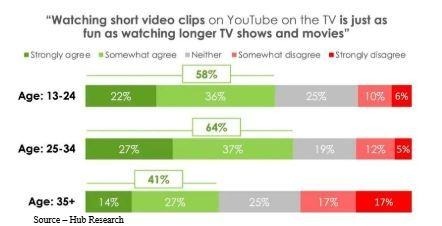
Digital Generation – Gen Z and Millennial viewers don’t really differentiate between the social media videos they watch or long-form movies/shows. It’s all just … entertainment.
But unlike traditional shows/film work the creator pays for the content production and marketing with creators
getting a share of the ad revenue based on the number of followers and traffic.
Today’s independent creators drive significant portion of YouTube’s daily viewing traffic with Gen Zs finding it more relevant than TV shows/movies.
Only a small percentage of social media creators make “a living” with their video work but a few have risen to
the top with large audiences, advertising/endorsement contracts, merchandising, other ventures and well as
national/international recognition.
These include MrBeast ($85M), Dhar Mann ($56M), Jake Paul ($50M), Matt Rife ($50M) and others who rank
in the top 20 social media creators.
And with followers, that range from 10M to 816M they have also attracted the attention of streaming services.
Mr. Beast contracted with Amazon Prime this past year to create a Squid Game type show which Amazon called a success because it attracted 50M viewers in 25 days with over half of the audience being global – India, UK, Mexico, etc.
While many tracking firms aren’t as glowing about the show as Amazon, the show did provide the company
with a wealth of new and different viewer/user data which is perhaps even more valuable.
Even Netflix’s Sarandos has taken notice, saying that there are a number of social video creators who might
help the streamer reach and convince a new audience that they have been able to gain in the past.
Gen Zs assisted the total entertainment audience in pivoting from traditional V and movies to short-form, mobile-first content and the entertainment services are adjusting to meet the evolving market’s interests/demands.
And … more is never enough.

The entertainment industry continues to evolve with new and different opportunities for creatives and the audience.
Like it or not, we have to remember what Otter said in Animal House, “Don’t think of it as work. The whole point is just to enjoy yourself.”
The only problem is change is never easy and never fun, especially when we’re trying to figure out what entertainment will look like … when we get there.
Andy Marken – andy@markencom.com – is an author of more than 800 articles on management, marketing, communications, industry trends in media & entertainment, consumer electronics, software and applications. He is an internationally recognized marketing/communications consultant with a broad range of technical and industry expertise especially in storage, storage management and film/video production fields. He also has an extended range of relationships with business, industry trade press, online media and industry