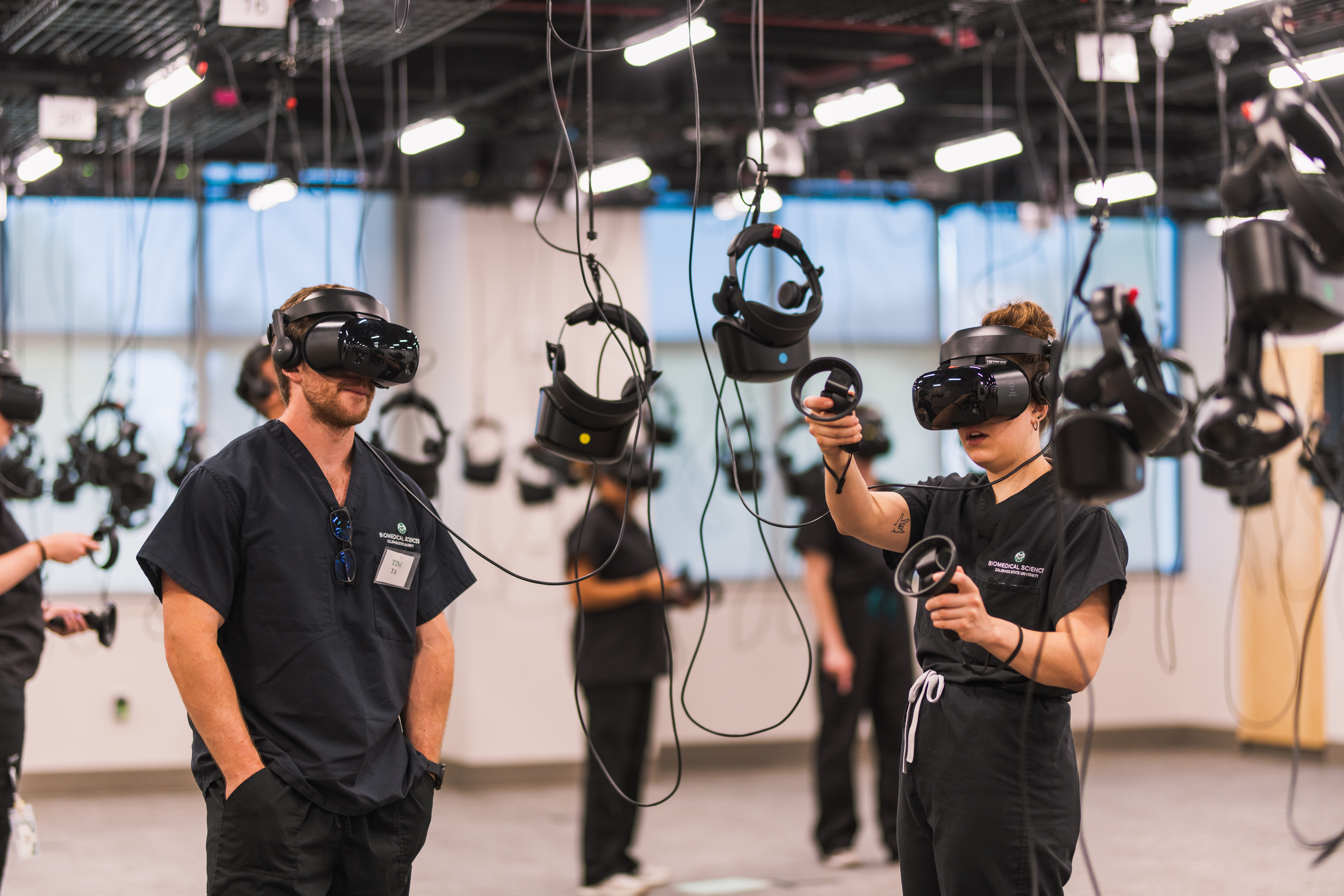
CHARLOTTESVILLE, Va.–(BUSINESS WIRE)–In a groundbreaking collaborative effort, all six medical schools across the state of Virginia recently united to explore the use of virtual reality (VR) technology in medical education. The collaboration, still early in its efforts, aims to provide a new mode of practical training that can help medical educators combat the increasing cadaver shortage faced by medical schools across the country. Virtual reality presents an attractive solution to this problem not only because of its ability to diminish reliance on cadaver use, but also because of the enhance capabilities for distance education and increased student engagement.
The consortium convened in late July on UVA’s campus for a meeting of the Virginia Association of Human Anatomical Sciences (VAHAS). Along with representation from each of the medical schools, the attendees were joined by Perspectus VR, a leading education technology company that helps medical schools and hospitals to create customized, virtual reality education content and curriculum. The symposium provided a platform for these educators, technologists, and medical professionals to deliberate on the integration of virtual reality tools into medical training curricula.
Reducing Reliance on Cadavers for Anatomy Training
Traditionally, medical students have relied heavily on cadaver dissection for hands-on anatomy training. However, the availability of cadavers has declined in the last two decades, leading medical educators with options such as 2D pictures and anatomical molds to train students on anatomy. The adoption of virtual reality in anatomy training offers a sustainable and ethical solution, allowing students to explore the intricacies of the human body in a digital environment without the need for physical cadavers.
Improving Education Quality with Advanced Training Tools
The primary objective of this collective effort is to elevate the standard of medical education by incorporating cutting-edge virtual reality technology. By leveraging VR, medical schools aim to create immersive and realistic training experiences for students. This approach will enable students to practice more often and in life-like scenarios that improve practical skills and decision-making abilities.
Dr. Tod Clapp, Associate Professor of Medicine at Colorado State University, and inventor of the Perspectus software, expressed his enthusiasm for the project, stating, “Colorado State University & University of Colorado’s medical programs went on a similar journey only a few years ago, and today, I’m proud to say that every new medical school graduate in the state of Colorado leverages Perspectus VR for their training. We’re graduating doctors all over the state who have a stronger grasp on anatomy and innovative technology- both foundational and futuristic skills. It is exciting to see the Commonwealth of Virginia on the same path.”
Enhancing Long-Term Capabilities for Medical Education
The global landscape has seen a rapid evolution in the field of education, with technology and distance learning becoming increasingly prevalent. While medical education has been more resistant to these changes than other higher educational programs, they too have been feeling the pressure to adapt to a more student-centric version of the traditional classroom.
Erick Miranda, COO of Perspectus and one of the meeting attendees, stated “incorporating VR technology into medical education does require some flexibility and commitment by faculty. The use of pre-packaged content and simulations are non-starters however, because of how rigorous and expansive medical school curriculum is. Perspectus puts VR in the hands of the educators, allowing them to utilize advanced data visualization technology to efficiently create an unlimited amount of customized VR content.”
Discussions between these parties are scheduled to continue this next spring, with the potential for virtual reality integration in time for the 2024-25 school year.
For further information on this exciting partnership and its impact on medical education, please contact: Erick Miranda at EMiranda@perspectustech.com
Contacts
Erick Miranda
EMiranda@perspectustech.com
Ojai Vision Recovery System pairs air compression, heat, vibration and Bluetooth® audio in a full-blackout…
New studio helps game teams scale engineering, art, QA, production, LiveOps, and player support around…
Configurable waveguide display gives defense and security customers a significant jumpstart for their custom wearable systemsROCHESTER,…
Five days of programming will span AI upskilling, health innovation, govtech, entrepreneurship, executive leadership and…
Plus: Top Cineverse FAST Channels including The Dog Whisperer and The Bob Ross Channel Now…
IRWINDALE, Calif., Sept. 29, 2026 /PRNewswire/ -- Auction Excess will feature professional post-production equipment from…