Vadzo Compares Global Shutter USB Camera Products: Sony Pregius S IMX900 Sensor vs Onsemi AR0234 Sensor for Precision USB Camera Imaging
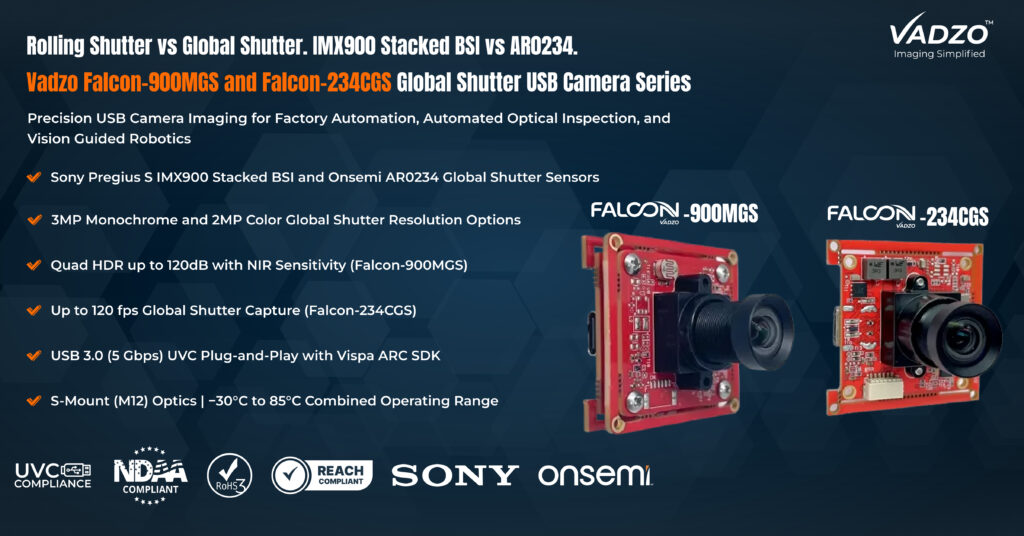
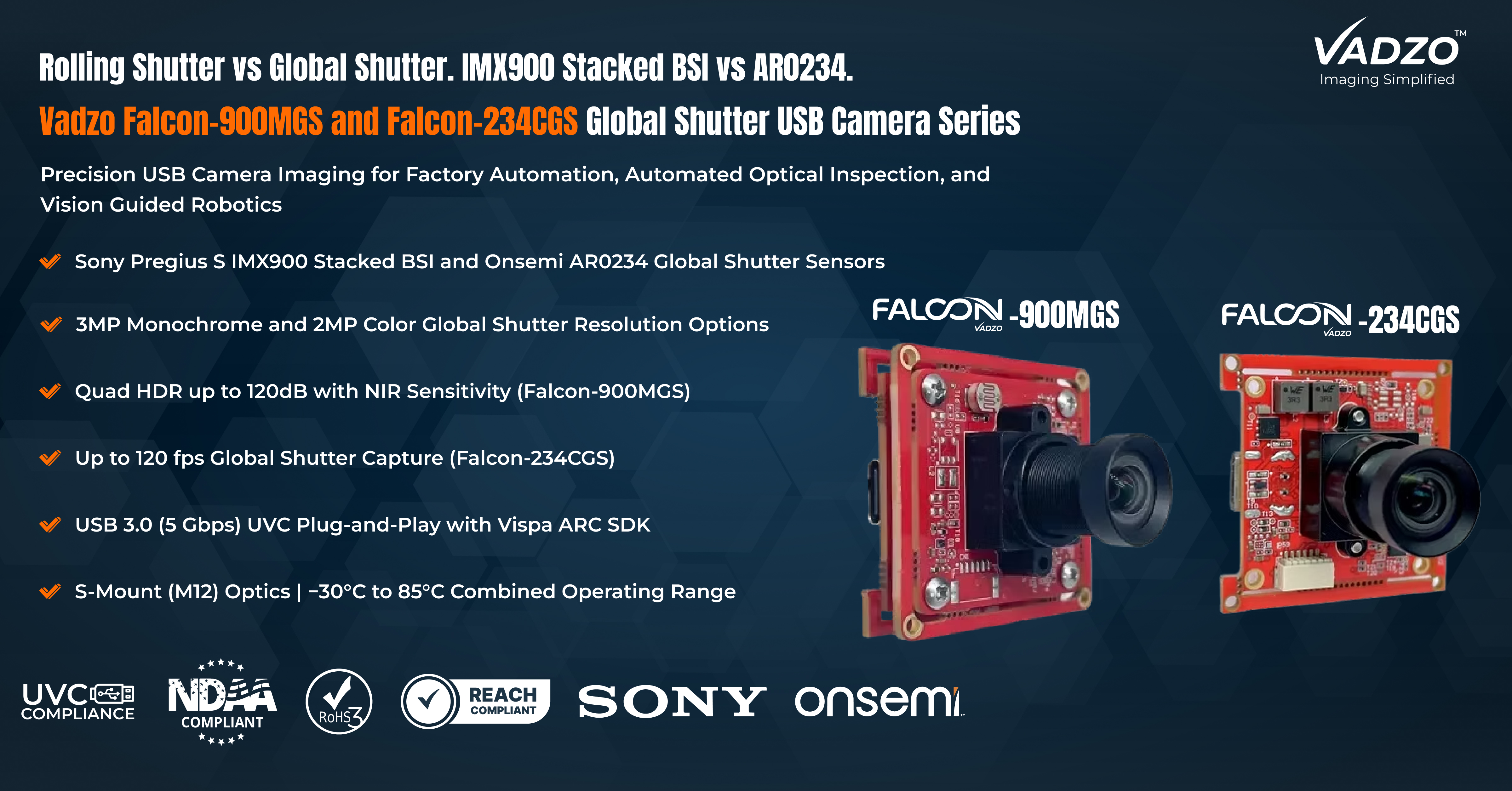
Vadzo Imaging is publishing an engineering comparison between the Sony Pregius S IMX900 stacked BSI sensor and the Onsemi AR0234 sensor across two products in its Falcon USB camera portfolio, the Falcon-900MGS 3MP Monochrome USB Camera and the Falcon-234CGS 2MP Global Shutter USB Camera, addressing the sensor architecture decisions behind rolling shutter and global shutter selection in precision imaging. Both platforms are built for factory automation, camera-based automated optical inspection, and vision-guided robotics deployments where resolution, frame rate, and spectral sensitivity define system performance at the sensor level.
IRVINE, CA / ACCESS Newswire / August 6, 2026 / Vadzo Imaging, a provider of embedded vision camera products for OEMs and system integrators, today releases an engineering comparison addressing one of the most consequential sensor decisions in precision machine vision. choosing between a stacked BSI global shutter sensor built for dynamic range and spectral reach and a conventional BSI global shutter sensor built for frame rate and cost efficiency. The comparison is grounded in two products from Vadzo’s Falcon USB Camera series, the Falcon-900MGS built on the Sony Pregius S IMX900 and the Falcon-234CGS built on the Onsemi AR0234, each addressing a distinct requirement within automated optical inspection metrology and vision-guided robotics architectures.
The Sensor Level Problem Behind Precision Imaging Failures
Precision imaging systems that track moving parts, robotic end effectors or conveyor-mounted components share a common point of failure at the sensor level. A rolling shutter sensor reads pixel rows sequentially rather than capturing the full frame at once. When the subject or the camera platform moves during that readout window, each row records a slightly different position, producing skew, wobble and geometric distortion in the output frame. In automated optical inspection, this distortion introduces a measurement error large enough to trigger false rejects at production line speeds. In vision-guided robotics, it corrupts the spatial reference a robot controller uses to calculate a pick or place coordinate. The decision between rolling shutter and global shutter architectures is well established for motion-critical tasks. A global shutter sensor exposes every pixel simultaneously, eliminating this class of error as a hardware-level guarantee rather than a software correction applied after the fact. The open engineering question is not whether to select a global shutter but which global shutter sensor architecture matches the resolution, frame rate and spectral requirement of the task.
Sensor Architecture: Stacked BSI vs Conventional BSI Global Shutter Design
The Sony Pregius S IMX900 is built on a stacked back-illuminated architecture where the pixel layer and the logic layer are fabricated on separate wafers and bonded together rather than sharing a single silicon plane. This stacking frees up area on the pixel layer otherwise consumed by readout circuitry, allowing a larger fill factor and improved photon collection efficiency per pixel. The stacked design also reduces per-pixel read noise, making the IMX900 a low-noise global shutter sensor suited to low-light and near-infrared imaging. Combined with a 2.25 µm pixel pitch and 3MP resolution, the IMX900 delivers Quad HDR up to 120dB and high sensitivity across visible and near-infrared wavelengths, making it the correct choice as a high-sensitivity global shutter camera in mixed lighting and NIR-illuminated deployments.

The Onsemi AR0234 uses a conventional back-illuminated global shutter design at a 1/2.6-inch format with a larger 3.0 µm pixel pitch. Without the stacked logic layer, the AR0234 trades some of the IMX900’s dynamic range headroom for a simpler, lower-cost sensor stack capable of reading the full 2MP frame at up to 120 frames per second. The larger pixel pitch also improves per-pixel light-gathering area and widens the depth of field margin at a given focal length, benefiting applications where working distance varies. Neither architecture is universally correct. The IMX900 stacked BSI design is the right global shutter USB 3.0 camera choice when dynamic range and near-infrared sensitivity are the limiting variables. The AR0234 is the right choice when frame rate and per-unit cost are the limiting variables at 2MP resolution.
Falcon-900MGS: Sony Pregius S IMX900 Stacked BSI Monochrome Global Shutter USB Camera
The Falcon-900MGS is Vadzo’s 3MP Monochrome USB Camera built on the Sony Pregius S IMX900 stacked BSI sensor, delivering 2064 x 1552 resolution with a 2.25 µm pixel and Quad HDR up to 120dB. As a Sony Pregius S IMX900 camera, it inherits the stacked BSI fill factor advantage described above, and as a monochrome sensor, it removes the Bayer filter mosaic entirely, routing the full photon flux at every pixel across both visible and near-infrared wavelengths. This makes the Falcon-900MGS a 3MP Global Shutter USB Camera option delivering the accuracy expected of a high-precision vision camera for structured light profiling, laser triangulation and fine feature automated optical inspection camera work where every additional line pair of resolution improves defect detection confidence. As an IMX900 USB camera platform, it pairs stacked BSI sensitivity with a 5 Gbps USB 3.0 interface and an operating range of −30°C to 70°C, making the Falcon-900MGS an IMX900 machine vision camera suited to continuous production line deployment.
Falcon-900MGS Specifications
|
Falcon-900MGS
|
|
|
Sensor
|
Sony Pregius S IMX900
|
|
Resolution
|
3MP (2064 x 1552)
|
|
Shutter Type
|
Global Shutter
|
|
Sensor Format
|
1/3.1″
|
|
Pixel Size
|
2.25 µm
|
|
Dynamic Range
|
Quad HDR (up to 120dB)
|
|
Spectral Sensitivity
|
NIR Sensitive Monochrome
|
|
Interface
|
USB 3.0 (5 Gbps)
|
|
Lens Mount
|
S-Mount (M12)
|
|
Operating Temperature
|
−30°C to 70°C
|
Falcon-234CGS: Onsemi AR0234 Color Global Shutter USB Camera
The Falcon-234CGS is Vadzo’s 2MP Color USB Camera built on the Onsemi AR0234 sensor, delivering 1920 x 1200 resolution at up to 120 frames per second with full global shutter capture. Its Bayer color filter array preserves color fidelity for tasks where color classification carries verification value, such as color-coded fiducial tracking and label inspection. As a 2MP color global shutter camera, the Falcon-234CGS gives vision-guided robotics and factory automation camera integrators a higher frame rate, lower-latency alternative to the Falcon-900MGS when color output is required and 2MP resolution is sufficient. The sensor also operates as an AR0234 machine vision camera across an extended −40°C to 85°C range, supporting deployment in both climate-controlled and unheated warehouse environments.
Falcon-234CGS Specifications
|
Falcon-234CGS
|
|
|
Sensor
|
Onsemi AR0234
|
|
Resolution
|
2MP (1920 x 1200)
|
|
Shutter Type
|
Global Shutter
|
|
Sensor Format
|
1/2.6″
|
|
Pixel Size
|
3.0 µm
|
|
Frame Rate
|
Up to 120 fps
|
|
Spectral Sensitivity
|
Visible Color (Bayer)
|
|
Interface
|
USB 3.0 (5 Gbps)
|
|
Lens Mount
|
S-Mount (M12)
|
|
Operating Temperature
|
−40°C to 85°C
|
Key Capabilities of the Falcon-900MGS and Falcon-234CGS
Global Shutter Precision for Motion Sensitive Precision Imaging: Both the Falcon-900MGS and the Falcon-234CGS expose every pixel in the frame simultaneously, delivering geometrically accurate captures regardless of platform or subject motion. On a factory automation camera line running at 0.5 to 2 meters per second, a rolling shutter sensor accumulates measurable row skew across the readout window, an error that a global shutter camera architecture eliminates at the point of capture. For automated optical inspection camera stations verifying dimensional tolerance or surface defects, this is the difference between a repeatable measurement and one that varies with line speed.
Resolution vs Frame Rate: Matching GSD to the Inspection Task: Ground sample distance, or GSD, is the scene distance represented by a single pixel, and it is the parameter that determines whether a defect or a fiducial mark is resolvable. The Falcon-900MGS 2.25 µm pixel pitch at 3MP resolution delivers a finer GSD at a given focal length suited to fine feature metrology global shutter camera tasks. The Falcon-234CGS 3.0 µm pixel pitch at 2MP resolution delivers a wider per-pixel field of view and a faster 2MP global shutter USB camera readout suited to high-speed global shutter camera tasks such as pick and place tracking where cycle time matters more than sub-pixel resolution. The Falcon-900MGS IMX900 global shutter USB camera configuration is validated across its full −30°C to 70°C range while the wider AR0234 temperature tolerance extends coverage into unconditioned facilities.
NIR Sensitivity and HDR for Mixed Lighting Environments: The IMX900 stacked BSI architecture inside the Falcon-900MGS extends sensitivity into the near-infrared spectrum and pairs it with Quad HDR up to 120dB for scenes containing both direct inspection lighting and shadowed regions in the same frame. This hdr global shutter camera capability suits metrology and inspection cells where illumination is rarely uniform across the full field of view. The Falcon-234CGS covers standard visible spectrum color tasks where illumination is more controlled and consistent.
USB 3.0 Connectivity for Plug and Play Integration: Both products connect over USB 3.0 at up to 5 Gbps with full UVC compliance, giving OEM integrators plug-and-play recognition on Windows, Linux, and Android without custom driver development. As a global shutter USB 3.0 camera platform, the Falcon series removes board-level integration risk from precision imaging deployments where engineering time is better spent on application logic than driver development.
“Engineers ask us which global shutter sensor to choose as if there is a single right answer. There is not. The IMX900 stacked BSI architecture inside the Falcon-900MGS gives you resolution, dynamic range, and near-infrared reach. The AR0234 inside the Falcon-234CGS gives you frame-rate color output and a lower cost per unit. The correct choice depends entirely on what the inspection or robotics task is actually measuring and at what speed. Our job is to make sure engineers have the sensor-level detail to make that call correctly the first time.” – Alwin Vincent, Product Manager, Vadzo Imaging
Target Applications
Factory Automation and Automated Optical Inspection: Surface defect detection, dimensional metrology and inline quality control on production lines require a global shutter camera architecture that holds spatial accuracy at line speed. The Falcon-900MGS automated optical inspection camera configuration suits fine feature defect detection and metrology global shutter camera tasks where sub-pixel accuracy and dynamic range under mixed inspection lighting matter most. The Falcon-234CGS covers color-based sorting and label verification stations as a factory automation camera where frame rate and color classification take priority over maximum resolution.
Vision Guided Robotics and Pick and Place Systems: Robotic arm tracking, pick-and-place coordinate calculation and cobot workcell perception depend on a spatially accurate frame delivered without motion-induced distortion. The Falcon-234CGS 120 frames per second capture makes it an effective AR0234 vision-guided robotics camera for high cycle rate pick and place lines, while the Falcon-900MGS structured light capability positions it as a capable IMX900 pick and place camera for robotic assembly guidance. The Falcon-234CGS also functions as an AR0234 cobot vision camera in collaborative robot workcells where geometric accuracy at close range is critical to safe operation. Beyond fixed coordinate calculation, both products serve as a global shutter motion capture camera for trajectory verification. Both operate as part of Vadzo’s automation and robotics camera module portfolio.
Security and Surveillance: Perimeter monitoring and asset tracking applications that require motion-accurate capture at variable subject distance benefit from the same global shutter guarantee that serves industrial inspection. The Falcon series functions as a surveillance camera option within Vadzo’s security and surveillance camera portfolio wherever rolling shutter distortion would otherwise compromise identification or tracking accuracy at the perimeter.
VISPA ARC SDK: Unified Control Across the Falcon Global Shutter Camera Series
The Falcon-900MGS and Falcon-234CGS are both supported by Vadzo’s VISPA ARC SDK, providing programmatic control over streaming exposure gain, white balance region of interest configuration, GPIO and firmware updates. The SDK supports C, C++, and Python across Windows, Linux, and Android platforms. Both products also operate natively under UVC V4L2 and DirectShow without any proprietary driver dependency, reducing integration overhead for OEM teams building mixed sensor precision imaging camera deployments across factory automation and vision-guided robotics platforms.
Frequently Asked Questions
Q1. What is the difference between rolling shutter and global shutter in a precision imaging camera?
A rolling shutter sensor exposes each row of pixels at a slightly different moment, scanning through the frame from top to bottom. When the subject or the camera platform moves during that scan, each row captures a slightly different position, producing skew, wobble and geometric distortion in the output image. A global shutter sensor exposes every pixel at exactly the same instant, eliminating this distortion entirely regardless of how fast the subject or platform is moving. For automated optical inspection, metrology and vision-guided robotics, this distinction determines whether a measurement or a coordinate calculation is trustworthy at production speed. Vadzo Imaging’s Falcon USB Camera series addresses this directly with two global shutter platforms. The Falcon-900MGS is built on the Sony Pregius S IMX900 for higher resolution and dynamic range, and the Falcon-234CGS is built on the Onsemi AR0234 for higher frame rate and color output, giving OEM engineers a global shutter option matched to their precision imaging task.
Q2. Which sensor delivers better performance for machine vision, the Sony Pregius S IMX900 or the Onsemi AR0234?
Both are global shutter sensors, but they are optimized for different variables. The Sony Pregius S IMX900 uses a stacked back-illuminated architecture at 3MP resolution with a 2.25 µm pixel pitch, delivering Quad HDR up to 120dB and extended near-infrared sensitivity making it the stronger choice when dynamic range and spectral reach are the limiting factors. The Onsemi AR0234 uses a conventional back-illuminated global shutter design at 2MP resolution with a larger 3.0-µm pixel pitch, enabling up to 120 frames per second readout and a lower-cost sensor stack, making it the stronger choice when frame rate and per-unit cost are the limiting factors. Vadzo Imaging offers both sensors in its Falcon USB Camera series. The Falcon-900MGS for the IMX900 configuration and the Falcon-234CGS for the AR0234 color configuration, allowing engineering teams to evaluate both against their actual GSD and cycle time requirements before committing to a production sensor.
Q3. How does global shutter capture improve accuracy in automated optical inspection systems?
Automated optical inspection systems measure dimensional tolerance and detect surface defects on parts that are frequently in motion on a conveyor or index table. A rolling shutter sensor reading out rows sequentially introduces a skew proportional to the part’s velocity during readout, and that skew shows up as measurement error in the inspection algorithm. A global shutter sensor captures the entire frame in a single instant so every pixel represents the exact same moment regardless of conveyor speed. This eliminates a whole category of false rejects and missed defect outcomes without requiring any change to line speed or lighting. Vadzo Imaging’s Falcon-900MGS automated optical inspection camera configuration built on the Sony Pregius S IMX900 adds Quad HDR up to 120dB on top of global shutter capture handling mixed direct and shadowed lighting common on real inspection lines, while the Falcon-234CGS provides a faster 2MP alternative for color-based sorting and label verification.
Q4. What ground sample distance is required to resolve small defects in a metrology camera?
Ground sample distance or GSD is the physical scene distance represented by one pixel, and it is calculated as pixel pitch multiplied by working distance divided by focal length. Reliably resolving a defect generally requires at least two to three pixels across its smallest dimension. For example, a sensor with a 2.25 µm pixel pitch at a 300mm working distance with a 25mm lens produces a GSD of approximately 0.027mm per pixel, meaning a 0.1mm feature spans roughly 3.7 pixels comfortably within range. A sensor with a larger 3.0 µm pixel pitch requires a shorter working distance or a longer focal length to hit the same GSD target. Vadzo’s Falcon-900MGS with its 2.25 µm pixel pitch and Falcon-234CGS with its 3.0 µm pixel pitch give metrology global shutter camera engineers two-pixel geometry options to run this calculation before finalizing lens selection.
Q5. What USB camera is best suited for vision guided robotics and pick and place applications?
The right camera for vision-guided robotics depends on whether the task prioritizes cycle time or spatial resolution. Pick and place systems that track parts moving at high speed on a feeder or conveyor benefit most from a higher frame rate global shutter sensor that keeps pace with robot cycle time without introducing motion blur into the coordinate calculation. Tasks involving structured light 3D profiling or fine feature part recognition benefit more from higher resolution and near-infrared sensitivity. Vadzo Imaging’s Falcon-234CGS delivers 2MP color global shutter capture at up to 120 frames per second, making it well suited to high-speed pick-and-place tracking and cobot vision workcells, while the Falcon-900MGS delivers 3MP monochrome global shutter resolution with Quad HDR and near-infrared sensitivity for robotics tasks requiring finer spatial detail. Both connect over USB 3.0 with VISPA ARC SDK support for direct integration into a robot vision pipeline.
Availability
The Falcon-900MGS Sony Pregius S IMX900 Monochrome USB Camera and the Falcon-234CGS Onsemi AR0234 Color USB Camera are both available now for evaluation and OEM integration. Engineering teams can access full technical datasheets and SDK documentation directly through Vadzo Imaging or contact Vadzo’s sales team for volume pricing and production support.
About Vadzo Imaging
Vadzo Imaging develops embedded and machine vision camera products for OEMs and system integrators building production-ready vision systems across industrial automation, robotics, healthcare and smart infrastructure. The company’s camera portfolio spans USB, MIPI CSI-2, GigE, Wi-Fi, and SerDes interfaces, supporting a wide range of embedded deployment architectures. Vadzo provides end-to-end imaging support, including sensor integration, ISP tuning, firmware development, and SDK frameworks to accelerate system deployment.
Media Contact
Alwin Vincent
Vadzo Imaging
Email: alwin@vadzoimaging.com
LinkedIn: Vadzo Imaging
YouTube: Vadzo Imaging
X: Vadzo Imaging
SOURCE: Vadzo Imaging
View the original press release on ACCESS Newswire