
Streaming Could Lead to Better Ads, Enhanced Experiences
Content Insider #950 – Evolving
By Andy Marken – andy@markencom.com

“You get a golden payday, you get a handshake, and you get released from your contract. Enjoy the next 30 years. This job doesn’t tend to attract the most forward-thinking people.” Joe, Looper, TriStar Pictures, 2012
The doctors for a couple of friends of ours finally diagnosed their long-suffering malady – ad intolerance.
It’s sorta like lactose intolerance … when an ad hits their senses, they have violent reactions.
The home entertainment industry caused the illness and it’s spreading around the globe.
Fortunately, it’s something that can be cured if the industry really wants to cure it … honest.
Like most things (today’s AI hysteria), it started innocently enough in a small office.
A couple of guys in Silicon Valley experimented with the idea that it would be neat to let people watch the entertainment they want, when they want, as much as they want, on the screen they want–all without ads.
And they’d make it cheap enough for all of us to enjoy — $8/mo. or about the cost of two cups of coffee.
Almost every studio, network and tech firm jumped on the idea, and it spread … rapidly.
Today, there are more than 200 similar offerings in the Americas, 600 more globally and each one ridiculously cheap.
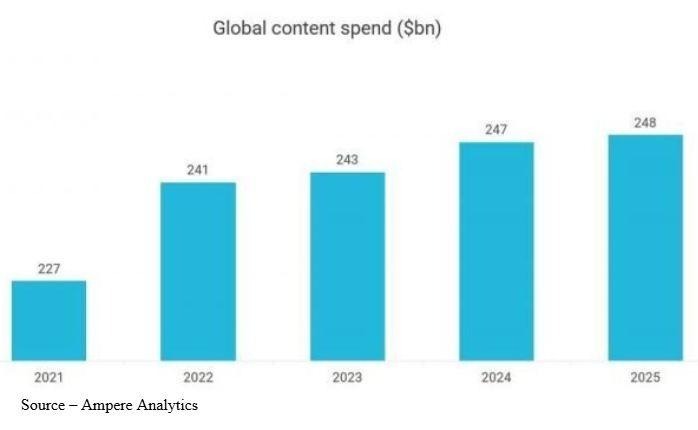
To get their unfair share of the estimated 1.8B subscribers, they’re investing roughly $248B this year and more in the future for a market that’s projected to be $417B by 2030.
While the average streaming subscriber pays for 3-4 services, people constantly change services with an average churn of 15-20 percent.
That means streaming services spend a lot replacing lost subscribers (lost income).

As my dad often liked to repeat, “You can’t lose a little on each sale and make it up in volume.”
But first, let’s be brutally honest.
As a profitable business model, the stand-alone the ad-free content creation, production, streaming distribution industry … ain’t!
Even slowly, raising monthly fees isn’t sufficient to recover the continuous content acquisition/creation costs.
But there is a path to profits for the streamers.
Yep … advertising!
It wasn’t that long ago that Netflix co-CEO Ted Sarandos had to walk back his former boss’s (founder now chairman Reed Hastings) long-held commitment to subscribers – no advertising – and advance the idea that perhaps ads might be a valuable tool for optimizing ROI.
It’s possible because streaming technology and its advances as weak as the streamer’s enhanced ability to know more about viewers than they might know about themselves can really benefit marketers and subscribers/viewers.
They can closely analyze, cross-pollenate and distill all of that information to understand in precise detail their audience as individuals and as a whole.
Then they can use that information to assist advertisers in reaching specific people instead of the entire viewing audience.
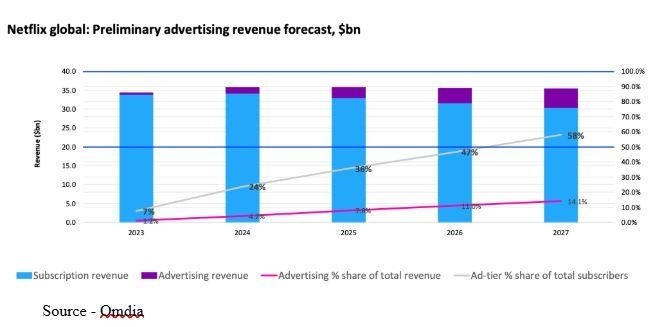
All they had to do was offer a “bargain-” priced streaming plan that includes “a few relevant” ads with each movie/show they watch.
Netflix has already seen a significant increase in its ad-supported subscriptions and expects to see ad subscriptions boost revenue by $5.5B by 2027 while offering a significant uplift in the firm’s subscriptions and customer retention.

The Gen Z/Millennial crowd is very willing to watch ad-supported video content because they have grown up in the digital/YouTube/TikTok environment.
Older folks tolerate it because they’ve been waterboarded with ads for years by linear TV.
Twenty minutes of ads per hour makes you either numb, dumb or both.
But once folks become streaming entertainment viewers, they expect better.
In the new entertainment environment, people have clearly told streamers and marketers what they don’t want and what they want.
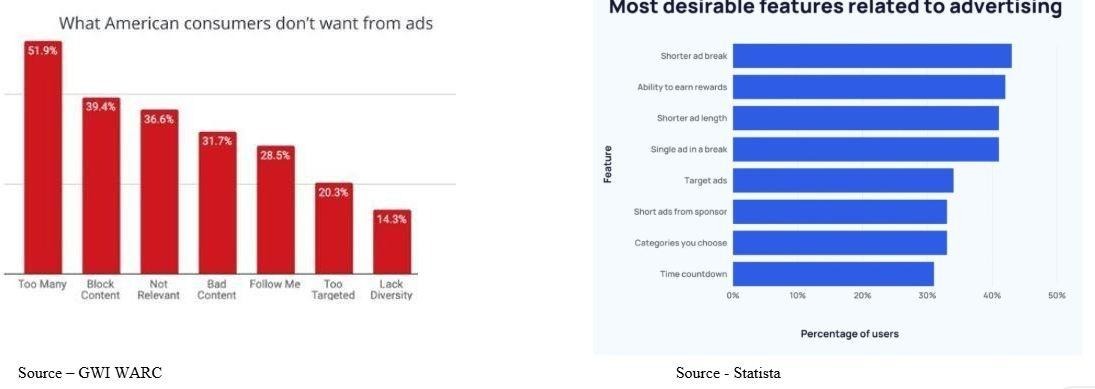
To bother viewers less, streaming services (the smart ones) are moving away from the traditional block of
commercials and experimenting with ad breaks, interactive ad formats and other new models enabled by the internet.
Netflix has gone so far as to provide Gen AI guidelines – Using Generative AI in Content Production – that will help advertisers be more efficient and more effective.
As the leading streaming service and with loftier goals, they have a vested interest in helping marketers improve their position with consumers in the evolving marketplace.
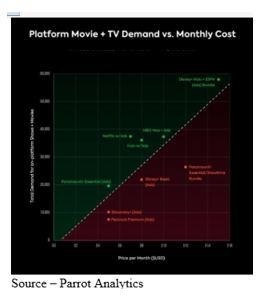
Real Value – There is often a considerable difference between what streamers feel their content is worth and what consumers believe it’s worth.
Obviously, everyone (streamers, advertisers, subscribers) has a different view of how valuable the content is and the return on investment.
Some services – Disney/ESPN, Prime Video and even Netflix – have shelled out about $12.5B this year for sports rights, knowing that consumers (mostly men) will spend a lot to watch their favorite events/teams including futbol, basketball, baseball, football, Lacrosse, cricket, wrestling, boxing, etc.
Combined, they have helped streamer bosses determine what the value/price will be to the subscriber as well as the service price to the consumer as well as the volume and price of ads in each of the events, shows, movies.
The most interesting streaming service was one that Fox One announced earlier this year with a monthly subscription of $20 even though they are “a little” uncertain of the level of interest from streamers who already have 3-6 six services they are paying for.
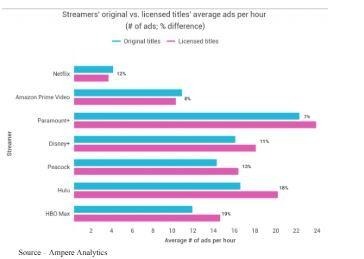
Weighted Difference – Depending on what they have in “inventory” and perceived interest levels, often determines how many ads will be added to original or licensed content.
Since Netflix has more original TV titles in their Americas catalog, these projects also show 12 percent more ads per hour for original titles relative to licensed titles. But if the ads are done right, you’ll never notice the number of ads but rather how they seem tailored to you.
HBO Max has the biggest gap in their ad placements with licensed titles having 19 percent more ads than originals.
At the same time, Disney+ and Hulu share content but they each add more ads to the other’s respective originals.
As for Prime Video, ads per project seem to almost be arbitrary and are often the more the merrier.
We will have to see how Paramount-Skylark adjusts the ad volumes for Paramount + but with the major restructuring that is underway and the investment in new content, no one anticipates any “volume adjustment” any time soon.

But … the user experience is still a “work in progress.”
The major problem is streaming content – shows/movies – have been written, directed and produced for binging and in the same form you would watch a project in the cinema … one continuous, uninterrupted viewing.
In the “old days,” directors/writers created scripts to accommodate ads with scene breaks and fade-outs.
But with streaming all of that planned interruption was shelved.
Creative teams were/are given freedom to tell a complete visual story without the bothersome interruptions of a countdown clock to tell you when the action/monologue could recontinue.
With the advent of ad-supported streaming content, directors/writers have to factor in the need for ads and develop transition points where ads can appear.
Across the industry, streamers and creators need to establish the flow of ads in the content – at the beginning, a couple of mid-streaming spots so viewers see the ads as almost a smooth transition or welcome relief in the action.
Without that planned transition, people will continue to hate whatever is being advertised.
In addition, since the streaming service knows the subscriber (intimately), we’re never certain why they feel we would be really interested in five – six accident lawyer or bent carrot ads.
You’ve got our data, entice advertisers who might/should be interested in hearing about and promoting something we’re even remotely interested in.

Streamers already offer a lighter ad load than linear TV – 4-8 min/hr. vs. 17 min with linear; but according to Parks Associates, 44 percent of consumers still feel there are too many ads.
Fewer ads aren’t exactly possible because they need to recover costs and deliver a satisfactory ROI for shareholders.
Presently, 51 per cent of streamers are satisfied with six minutes of ads per hour.
To meet the requirements of today’s new home/personal viewers, streaming services are experimenting with new ad formats that will be more interesting to viewers.
Free service Tubi found that standard video ads are currently preferred by viewers over other formats such as split screen, interactive, or QR code ads.
Addressable ads command higher prices because they involve the viewer (at least younger viewers) and enhance retention.
More relevant ads also rate higher (16 percent) in viewer satisfaction.
The increased use of AI can also assist in developing multiple creatives for a more dynamic, addressable ad acceptance.
All of the streamers are testing a variety of different ad types that are more acceptable to ad-supported streaming viewers including pause ads, preroll/midroll ads, Gen AI interactive ads and other more inclusive formats and content. Because everyone knows the variety, quality and placement of ads needs to improve.
Invasive, intrusive and stupid ads will be totally ignored by pre-Millennials who were raised on digital content and increasingly, by people have a lick of common sense and realize marketers have to earn their interest.
At the same time, advertisers want a high-quality content environment that enhances and compliments their brands because it also means there will continue to be a large and interesting audience that is interested in the personalized content and compatible ad experience.
There is a strong convergence of content, data and technology evolving that will benefit all parties – content producer/distributor, advertiser and consumer.
Directors and writers will create projects so they can be seen uninterrupted by the SVOD subscriber and with flow where ads can appear without cutting off dialogue or minimizing the show’s/movie’s entertainment value.
More importantly, advertisers will begin expanding the variety and quality of their ads as they grasp the fact that they are talking one on one with people who are or might be interested in their product/service rather than thousands of folks who don’t have a need or interest what they are pitching.

O.K., so it won’t happen overnight and will take a lot of work by the streaming service, content creator and advertiser but as Old Joe said, “Yes, this is a precise description of a fuzzy mechanism. It’s messy..”
Still, when it gets done and gets done right, everyone will benefit.
And who knows, it may even be a cure our ad intolerant friends will want to experience regularly.
Naw … never going to happen. They’re too set in their ways.
But at least we’ll enjoy great content, intelligent/interesting ads and less expensive home entertainment.
Andy Marken – andy@markencom.com – is an author of more than 1000 articles on management, marketing, communications, industry trends in media & entertainment, consumer electronics, software and applications. He is an internationally recognized marketing/communications consultant with a broad range of technical and industry expertise, especially in storage, storage management and film/video production fields. He also has an extended range of relationships with business, industry trade press, online media and industry analysts/consultants.