Creative Content Work is Filled with Uncertainty
Content Insider #967 – Clear As…
By Andy Marken – andy@markencom.com
Source – Mud, Mud, Lionsgate
“There are fierce powers at work in the world, boys. Good, evil, poor luck, best luck. As men, we’ve got to take advantage where we can.” – Mud, Mud, Lionsgate, 2013
A couple of years ago, the oft-murmured phrase in the content creation/production industry was “Survive ‘til ’25…
Last year, it was “Exist ‘til ’26,”
Now, with tremors across the industry, creatives in Hollywood, Atlanta, London, Budapest, Mumbai, Zhejiang Province, Tokyo, Busan, Sao Paulo, Nigeria, and every production location around the globe are wondering what the industry will look like when the dust settles.
The audience has changed, the depth/breadth/length of successful content has changed, the technology has changed, the centers of great content have changed, even the majors are struggling to understand what change is/should be.
Source – Lean Summits
Usually ignored, Gen X got in on the bleeding edge of technology giving birth to large, beautiful, low-cost home screens and smartphones combined with anytime, anywhere video stories shrinking the six degrees of separation and giving new meaning to consuming content on your terms.
Millennials quickly adopted the devices and entertainment routine.
But it was GenZs/Alphas who were born with a screen in their hands that tipped the scale when it comes to what is video entertainment content and how/when/where it is consumed?
Source – Zebracats
Today, the entertainment “industry” is more fragmented and personalized with the younger generations redefining the meaning of watching shows/movies.
The stuff they watch can be 3–10-minute serialized projects or one-offs.
Or, it can be professional, informational, entertainment, news, sports or influencer driven as long as it can be when they want, how they want, on the screen they want and for as long as they want.
It just doesn’t matter…they see social media content as more personal and relevant while streaming long form scripted content is more interesting, entertaining and immersive.
The dual/dualling content forms have created a quandary for professional content developers/creators, production teams and the money folks.
Until things settle down a little, they need to focus on staying in, defining and refining their own lane.
They can’t ignore short-form content but should use it to leverage, promote and enhance the visibility of their long-form projects, their expertise and their talents.
Most of the short form social media content is an end unto itself with a constant need to refresh and reconnect themselves and their work with the constantly changing tastes of an audience with abbreviated, constantly changing interests, memory spans and loyalties.
In other words, it’s a tough, never-ending treadmill.
Source – Documentary Film Academy
AI is here and it isn’t going away.
But it’s also like any creative tool.
It’s not the alpha/omega of content development/creation/production that AI nerds/evangelists want you to believe it is but frankly we believe your audience is smarter and more selective in the work they watch.
AI can and will be of considerable assistance to directors/producers/writers in honing a film/show idea based on a deeper understanding of the target audience and what satisfies their particular wants/needs.
Even if it’s a visual story you feel you just have to tell because you know people will fall in love with it, it has to have relatable characters; a universal theme like love/loss; shared emotional experience; a window into other cultures, perspectives, experiences and something that stays with you and sparks memories, values, emotions.
Those are human traits which AI can’t/won’t be able to develop/feel/express.
If it does…kiss the entertainment industry goodbye!
AI is very useful for researching for ideas surrounding the project concept enabling creators/writers to take a film/show down a specific path and explore all of the options to arrive at a strong, emotional conclusion that the film/show team wants to deliver to and leave with the audience.
AI can assist in considering camera angles and shot selection for emotion/impact, minimizing reshooting scenes/segments.
AI is already widely used by the post-production team to handle the minutiae of time-consuming and tedious work required to enable/allow the team to deliver a project that produces the desired impact and emotional satisfaction.
With professional creative guidelines established at the outset, critical decisions like flow, timing and project rhythm can be more quickly, easily and correctly made that not only ensure work meets their standards but will also interest, enthrall and meet/exceed the audience’s entertainment expectations.
Yes, there will be some who will want to use AI freely to ease/eliminate their creative workload because it’s a fast, easy way to make a buck but that isn’t creative, it’s production for production’s sake.
Those efforts can expect a lot of audience blowback and screen evacuation.
Even against this backdrop, studios/streamers and content creators have to read the tea leaves to determine which flavor of film/show genre they are most comfortable/satisfied with that will have the best chance of capturing a significant portion of the long form viewing audience in the theater or on their home/personal screen.
Source – Ted Hope, Substack
Now that most of the US households (85 percent) enjoy their content at home, studios and streamers have shifted their growth targets to the global audience.
They are selecting/greenlighting projects that appeal to the broadest set of international viewers possible.
Source – Ampere
And while they are steadily investing in new/different genres of content — US industry investments for last year were NBC Universal – $27.1B, Disney – $24B, Paramount – $18B, Warner – $19.5B, Netflix – $20B, Amazon – $10B, Apple $8B – and much of it went for local projects which could appeal to people in other countries.
Now that the streaming services have a growing volume of local and international data on viewing time and trends to optimize subscriber growth/retention.
Whether the film is going to have a theatrical window or go directly to streaming, superhero and franchise projects have slipped down the viewer’s gotta-see lists and are less frequently developed because of the cost/return.
Horror, thriller and action films/shows have enjoyed an uptick in greenlighting because they have broader appeal and they are more economic to develop/deliver.
In addition, because of the globalization of home entertainment and the economics of subs/dubs, people are now able to watch and enjoy a broader range of films/shows in these categories.
Source – Polaris Market Research
One of the most sustainable and increasingly popular categories of shows/films has been animation and the growing interest in anime, which grew to about $34B last year.
Films like Elio, Ne Zha 2, KPop Demon Hunters, The Bad Guys 2, Zootopia, Wild Robot and a growing number of projects from Sony’s Crunchyroll, and Asian studios have proven to have strong audience attraction in the theater and home.
While Ne Zha 2 was a collaborative effort with an estimated 4,000 professionals, more and more of the animation/anime production is being done by a core of creators supported by AI tools to deliver films/shows faster, better and with a lower overall cost.
Source – AP
And to broaden the films/shows audiences, studios and streamers are dubbing/subtitling the video stories in multiple languages to increase audience interest in North America, Europe, Latin America, the Middle East and Africa.
We find it interesting that subtitles (closed captions) have gained in popularity with individuals across all age groups – with and without hearing impairment.
Viewers are able to follow plots and understand speakers (regardless of how they increasingly mumble, whisper) and catch sound cues improving the overall experience of the movie/show, online video.
In addition, it’s a fun, entertaining way to brush up on or learn another language.
Streaming services are also finding another way to strengthen ties with subscribers and expand their profits.
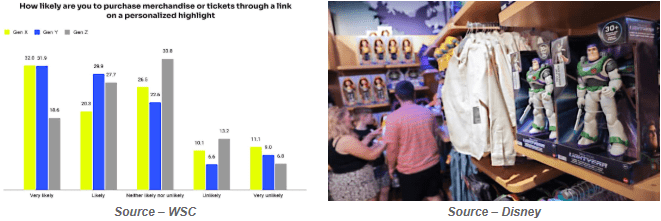
Added Connection – Merchandising has always been an integral part of sports and streamers have quickly adapted it as well but the real growth/profits have come from film/show merchandise now that streamers have made it simple for viewers to purchase simply through interactive ads.
Sports and live entertainment venues have always found their fanbases an excellent way to turn interest into profit and get people to pay for and promote teams, players and entertainers.
But streamers like Netflix, Prime and Apple have also taken a page from Disney’s ledger by offering show, film merchandise.
The streaming and merchandise fanbase is global and growing at an expected 16 percent over the next five years.
Animation and anime are being used a broad range of content, stories and genre to attract global viewers and they are also improving the studio/streamer bottom lines with the sale of merchandise to the GenZ/Alpha audiences.
All of this looks great for the content creation/production industry but…and there’s always a but.
Source – Lionsgate
Despite the fact that California, or more specifically Hollywood, has enjoyed a century-long leadership role in the creation of great films and shows, it is losing its “first choice” consideration for the place where people have to go to make their shows/movies.
Thanks to what seems to be a misguided feeling of self-importance, a failure to appreciate that outstanding locations exist and can be created anywhere – especially with today’s advanced VR studios – serious creation/production centers have cropped up around the globe.
While California/Hollywood has a seasoned creative workforce that consistently delivers films and shows people want to see, other locations across the country and around the world have seriously invested in people, techniques, technology and facilities that can do the same if not more.
As a result, film/show producers and investors have a multitude of choices.

Global Advances – Major new film/show production facilities and related the project support infrastructure work has taken place in states and countries around the globe as it represents strong growth potential for areas for fresh, exciting, low polluting and steady income for local governments and populations.
With people like actors Matthew McConaughey and Woody Harrelson and director Taylor Sheridan strongly pushing to make Texas the hub of the Southwestern US film/show center, state and local governments are funding and developing facilities, production training programs along with broad reaching incentive programs in Arizona and New Mexico to make it easy for studios, streamers and independents to choose the area for their next video project.
At the same time, New Jersey, New York, Georgia and other states are making it easier for them to move their video stories to other locals.
Toronto has been dubbed Hollywood North with impressive studio operations in Montreal, Vancouver and other Canadian locations across the country.
And for producers, project owners who want to stick in an English-speaking country Great Britian has become the second largest creative hub behind the US and slightly ahead of Canada.
They all offer a wide range of locations to meet the scenery needs for almost any project.
Source – WIPO
As though these weren’t enough options to meet the needs of the nearly 10,000 films and thousands of TV/streaming shows produced around the world last year, India produced nearly 3,000 films locally last year followed by China will about 1,000 and Japan with nearly 700.
Europe’s big five (France, Germany, Italy, Spain and the UK) as well as South Korea, Latin America, Australia have been aggressively soliciting and winning films/shows for local and international viewing.
In addition, all of the countries – with the exception of the US – offer a dizzying array of cash incentives, rebates, professional creative team assistance and ancillary support for local, regional and international productions.
In the US, individual states and production centers (including California/LA) offer a range of credit, rebate and reimbursement programs attached to a confusing array of what-ifs, and-ors that only increase the cost/frustration of film/show production.
Not only is housing expensive, but location shooting can also be frustrating, time consuming, and a needless pain as project teams wade through the county and local bureaucratic morass that has been introduced over time.
There are other hurdles teams have to jump over to make available specific buildings, streets, and neighborhoods for a day’s, week’s or longer shoot when films/shows venture outside of the studio.
Bureaucrats don’t understand – or don’t give a crap – that there is a budget (time/money) that the film/show industry has to manage.
Money is important but time can be even more costly.
Source – Lionsgate
Add it all together and it’s obvious that too much of tomorrow is outside of the individual independent creatives control which isn’t healthy for the industry or individual.
As Senior said as he watched the river flow in Mud, “A man should be in charge of his own affairs, but I haven’t worked it like that.”
Maybe he’s right when he mused, “Enjoy it while you live on it, ’cause this way a life isn’t long for this world.”
But something will be lost when creativity has to suffer for the sake of production.
Andy Marken – andy@markencom.com – is an author of more than 900 articles on management, marketing, communications, industry trends in media & entertainment, consumer electronics, software and applications. An internationally recognized marketing/communications consultant, he has a broad range of technical and industry expertise, especially in storage, storage management and film/video production fields. He also has an extended range of relationships with business, industry trade press, online media and industry analysts/consultants.