Visual Productions SpiNode and CueCore3 Power “Above the Roar” Immersive Experience at Niagara Falls State Park
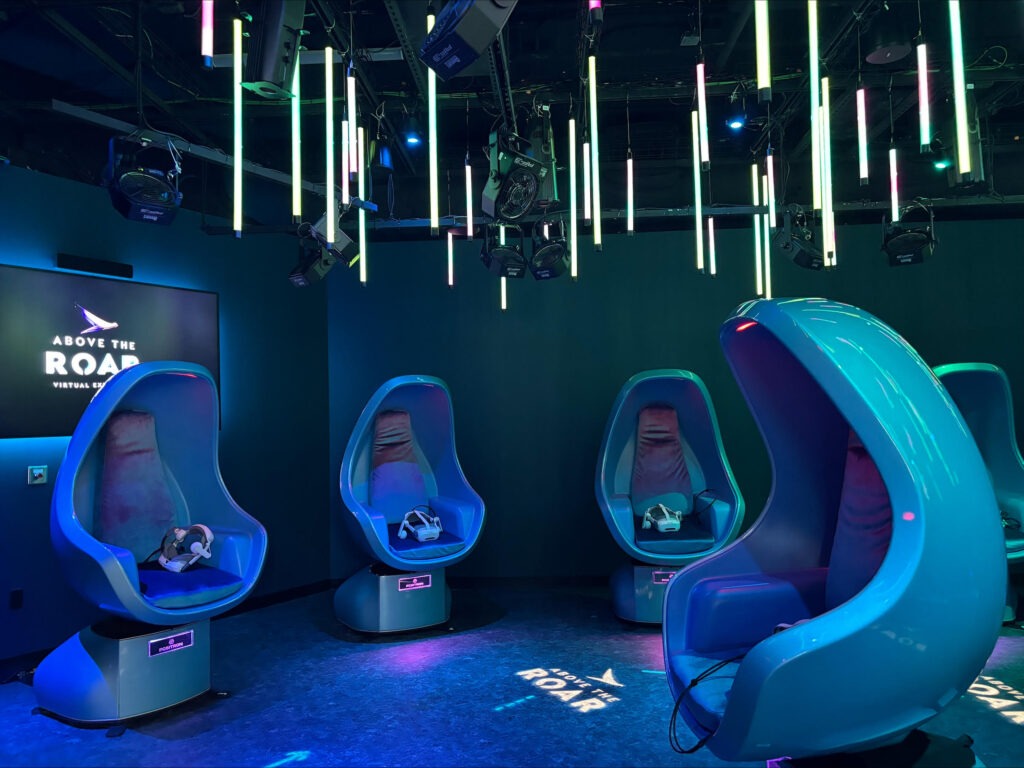
NIAGARA FALLS, NEW YORK, OCTOBER 26, 2026 ― Visitors preparing to experience the majesty of Niagara Falls can now begin the journey before stepping outside, with “Above the Roar,” an immersive VR attraction from the award-winning VR/XR company Positron. Operated by Delaware North Parks and Resorts — Niagara Falls State Park, “Above the Roar” transports guests high above one of the world’s most iconic natural wonders. Inside a cavernous environment, designed and produced by Orlando-based Experiential Design and Production Agency, MDSX, suspended LED fixtures, projected visuals and VR combine to create a seamless experience.
Behind the attraction is a carefully orchestrated audiovisual and lighting system designed, integrated and programmed by AVL Designer and Integrator, Luna Lux, with Visual Productions’ SpiNode and CueCore3 solutions providing critical pieces of the control infrastructure. Visual Productions isdistributed exclusively in North America by ACT Entertainment.
With Luna Lux Controls Designer Colin Postley at the helm for this project, the company oversaw everything from the lighting and sound system layout to the control architecture, with a key objective of ensuring the environment complemented, rather than competed, with the VR experience. “The lighting objectives of the project were really to be somewhat auxiliary to the experience itself,” says Postley. “The venue’s team wanted to give life to the space before and after the experience, for those who were in the VR pod, but then also to add some visual texture for those who are in the space but encountering it without the VR element.”
That meant designing a system capable of shifting between distinct visual states. The attraction’s suspended pixel fixtures contribute to the environment, which was set in a real cave, while additional fixtures provide pathway lighting and color. LED tape adds bias lighting around courtesy monitors, while projected gobo arrows help guide visitors through the space.
At the heart of the pixel control system are 48 Visual Productions SpiNodes, arranged in six enclosures containing eight units each. The unusually large number of independently controlled fixtures was one of the project’s defining technical challenges. Every suspended pixel fixture was wired separately, creating a significant cabling and output-management challenge. The compact form factor of the SpiNodes made it possible to distribute control hardware throughout the installation rather than pulling enormous bundles of cables back to a centralized location.
“With the sheer quantity of outputs needed, the ease of using the SpiNodes was extremely beneficial,” Postley explains. “The compact size of the devices made it easier to physically get them where they needed to be, and then the software and user interfaces were helpful for managing that number of outputs.”

While the SpiNodes handle the individual pixel outputs, Visual Productions’ CueCore3 serves as the system’s playback engine. Lighting sequences were programmed using an MA Lighting grandMA3 console and then recorded to the CueCore3 for playback, which enables Luna Lux to make future changes without a full console. CueCore3’s ability to interface with other Visual Productions devices and accept lighting data provides another layer of adaptability.
The result is a lighting system that subtly mirrors the attraction’s narrative and remains largely invisible to the visitor. During entry, blue tones evoke water dripping through a cavern. During the VR experience, the lighting shifts toward brighter whites and pinks inspired by the video content, which provides an engaging environment for guests who are not wearing headsets. Finally, the system moves into green and earth tones, suggesting the transition out of the cave and back into the natural landscape of Niagara Falls. “It helps give the non-VR attendees a timer, but also to not keep them in a cave while everybody else is in the sky,” Postley explains.
According to Postley, the value of the Visual Productions solutions extends beyond individual hardware features. “In an attraction where programming decisions inevitably evolve once designers are on site, flexibility and reliability are largely my two top factors when selecting a device,” he says. “When I can trust a device to do what it’s supposed to do consistently, it is very easy for me to recommend it to a client.”
Founded in 2012, Luna Lux provides lighting, AV and control design, system integration, procurement and technical services for story-driven experiences. The company works across museums, theme parks, experiential installations and live events, supporting projects from initial concept and design through installation and commissioning. Its studio and central warehouse are located in Dallas, with representation across North America.
“It’s an honor to support the folks at Luna Lux and the technology behind an installation as distinctive as ‘Above the Roar,’ which delivers a memorable new way for visitors to experience Niagara Falls,” says Ryan Hindinger, Market Manager, Lighting, ACT Entertainment. “This project demonstrates the kind of creative and technical results that can be achieved when an experienced design team has flexible, reliable control tools at its disposal. Visual Productions solutions play an important role in venues and attractions all over the world, and it’s exciting to add Niagara Falls to this incredible list.”