
“Use It or Else” Is Not an AI Implementation Strategy
Content Inside #968 – Managing
By Andy Marken – andy@markencom.com

Source – “Hitchhikers Guide to the Universe,” Touchstone Pictures
“In the beginning the universe was created. This made a lot of people angry and has widely been considered as a bad move.“ – Hitchhikers Guide to the Universe,” Touchstone Pictures, 2005.
Okay, let’s cut to the chase:
- Yes, we use AI – sparingly
- Your boss (probably) doesn’t know squat about what AI is and probably has difficulty spelling it
- Your boss wants everyone using AI because it means automation of tasks which generally means he/she can cut jobs
Yes, we use it for all of our Insider research. We search the internet a bunch of times, phrasing the subject dozens of different ways and then comparing the various data to sanity check what we write. phrasing the subject dozens of different ways and then comparing the various data to sanity check what we write.
And we use it – a lot – when we sit down in the evening to watch something with no particular show/movie in mind, which is most of the time.
No, we don’t use it to write an Insider. Whether good/bad, all our thoughts, ideas, writing is ours and most of the time, we’re happy with the streaming recommendations.
That’s about it…yep, that’s it!
That’s why the most immediate and widespread use of AI is in the technology industry; and even then, folks are dragging their feet. As Millennials growing up in the heart of the great technology shift, they focused on becoming an expert in his/her field and computers, software, smartphones were the tools they knew enough about to do their job…that’s it.
Source – CB Insights
Jensen Huang, president/CEO of Nvidia, whose chips are leading the charge in AI, reported during an all-hands meeting that the company had another record quarter on top of a series of record quarters.
They should, because they also have their fingers in almost every AI company there is and it’s making them a multi-trillion-dollar company.
Yet, he had to admonish his team because some folks are dragging their feet in using AI…everywhere.
Of course, he’s not alone in pushing his team to use AI.
Google CEO Sundar Pichai and Microsoft’s Satya Nadella have said they want their version of the “transformative technology” to be used everywhere but…
Source – RatiinalFX
He may have meant that when he said it, but spending money to retrain people for other jobs isn’t the first thing 90 percent of bosses think of when they roll out AI in their organizations.
Salesforce cut 4,000 positions, Accenture cut 11,000 folks, Amazon eliminated 14,000 jobs, Klanara shrunk their workforce 40 percent and the list goes on and on.
Source – BET Pictures
We’re going to give Huang the benefit of the doubt and believe that he really means it, but he’s in the minority.
It’s called stinkin’ thinkin’ and the reason why last year’s the MIT NANDA report – The GenAI Divide: State of AI in Business 2025 should be read by bosses at every level before they dive into the deep end of AI because most don’t have a clue.
It’s called stinkin’ thinkin’ and the reason why last year’s the MIT NANDA report – The GenAI Divide: State of AI in Business 2025 should be read by bosses at every level before they dive into the deep end of AI because most don’t have a clue.
The study showed that 95 percent of the pilot projects showed zero, nada, zip measurable returns while an S&P Global Market Intelligence survey found that 42 of the companies had abandoned most of their AI projects.
Source – Winklix
It’s easy – and almost logical – to see how company shareholders and management and maybe even you can be so enthralled with AI’s potential – increased efficiency, improved quality, increased competitiveness, answer skills shortages and new business revenue.
What’s not to like?
A lot of folks like to equate it with how computers changed the way people work, relax and live, but it’s different.
When computers were introduced, they were big, cumbersome things that only a few folks knew how to operate.
Source – Computer History Museum
The first ENIAC (Electronic Numerical Integrator and Computer) was introduced into the US about 100 years ago and “normal” folks didn’t interact and work with it.
In fact, the first team to work on it were women programmers.
It took a while for guys to figure it out.
There were years of trials, tribulations, setbacks and steps forward before it became ubiquitous in our lives.
Source – Futurepedia
Yes, AI was formally introduced 70 years ago, but it languished in labs for years doing specific tasks like playing chess until folks started working on and promoting the idea of artificial general intelligence.
ChatGTP — one of the most recognized AI brands with products in a bunch of flavors — is three, maybe five, years old. Other than being hyped as a super assistant, what it can do really well is carry out some well-planned, rehearsed demos folks like to brag about.
Each new exciting version – and most similar LLM products – was rushed to release to meet some artificial deadline, like a quarterly report, not really half tested to know what it does or how it does it, doesn’t really understand the physical/thinking world but is great at delivering hallucinations.
That’s probably why McKinsey found that two-thirds of companies are still in the pilot stage, and few (1-20) firms see any measurable contribution to earnings.
In fact, a Stanford study found 37 percent of Americans used GenAI tools at work, down from 46 percent three months earlier and the Federal Reserve Bank found 12.1 percent of working adults were using GenAI down from 12.6 percent the year before.
O.K., if you’re in a “programming” company, you sorta know management wants you to use it in your job but each of the above CEOs are betting their company’s future and theirs on using AI throughout their respective organization. All of those users were in tech companies – Nvidia, Google, Microsoft, Meta, etc. – where they had gentle suggestions…use it or else!
Aahh…yeah.
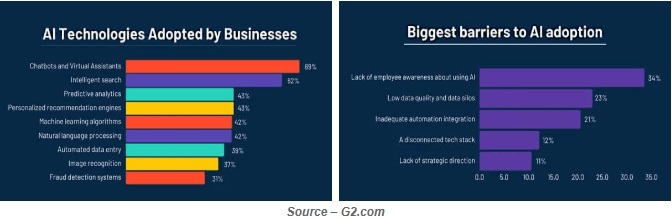
Promises, Problems – People love to hype all the things AI can do in practically every corner of the organization but they bypass/gloss over the obstacles which are many and ignoring them can lead to disaster.
That’s akin to someone dropping an ENIAC into the middle of a company 95 years ago and saying use it, improve what you’re doing, thrive and prosper, only worse.
You’ve been given this thing that “learns” from a ton of historical data/informatiion that is scraped from everywhere. It learns by interacting with you and systems/activities around it while updating its understanding in real-time and adjusting itself accordingly.
Then it will present you with a solution, sometimes with information it somehow fabricated itself. In AI’s defense, it didn’t know it was lying.
The problem is few executives understand what AI is/isn’t, have no real clue what it can do/can’t do and more importantly, what they want it to do.
So yes, it’s little wonder implementation fails because without a set of objectives at the outset, why do something that can/will totally disrupt the organization?
We’re not big fans of Amazon’s CEO Andy Jassy, “he” crammed so many ads into their Prime streaming service it feels like the old traditional TV days. But at least he told their 1.5M (but shrinking) employees why the company was all in with AI, everywhere possible and…things would change. it’s little wonder implementation fails because without a set of objectives at the outset why do something that can/will totally disrupt the organization.
We’re not big fans of Amazon’s CEO Andy Jassy, “he” crammed so many ads into their Prime streaming service if feels like the old traditional TV days, but at least he told their 1.5M (but shrinking) employees why the company was all in with AI, everywhere possible and…things would change.
In an open letter to employees he said, “As we roll out more Generative AI and agents, it should change the way our work is done. We will need fewer people doing some of the jobs and more people doing other types of jobs.”
He thoughtfully added, “We expect that this will reduce our total corporate workforce as we get efficiency gains from using AI.”
Source – TAG
Huge Hurdles – If the obstacles and unknown are too much for your organization, AI may not be right for you or you may want to pare back your implantation and proceed cautiously.
Bold statements like this are no guarantee that AI investments will pay off because financial benefits of AI have to be quantified against the cost of implementation and reorganization. They have to invest in new/different expertise and talents to develop, implement, manage the AI solutions.
They have plenty of data across their many operations, but it has to be quality data and organized data. In addition, data privacy/security risks will be a constant challenge.
Perhaps one of their biggest hurdles will be ethical considerations, algorithmic bias and regulatory challenges such as EU’s AI Act and others that will follow as soon as government officials understand it’s good/bad features.
Source – 20th Century Studios
The biggest stumbling block to implementation success is…management.
It’s too easy to think how easy it’s going to be and overlook BSG’s guideline to success – 10 percent algorithms, 20 percent data and 70 percent people, processes, cultural transformation.
Firms aren’t just adding AI to their operations, they are changing the way the organization gets things done–their entire workflow.
Source – Freepik
Even though AI shows the potential to improve an organization’s bottom line, few management teams measure their key performance indicators (KPI) for the organization, their teams and individuals.
AI advocates like OpenAI’s Altman, Google’s Pichai, Microsoft’s Nadella, Meta’s Zuckerberg and Amazon’s Jasse are slow to recognize and address the risks including IP infringement and privacy. They understand there will be organizational disruption and have teams involved in developing new processes and procedures.
Source – Gallagher
Plan Ahead – AI implementation failures are so high because few organizations or teams take the time to figure out where it will work the best, what it can do, how they could possibly reshape their business and how they are going to measure the success of their efforts.
We know, doing all that isn’t as much fun as having AI whip together your legal brief filing, throwing together your research report, making a video of wooly mammoths trotting toward you or a video of your pets doing dumb tricks, but you’re betting the farm on using this powerful, very flexible technology.
According to S&P Global Market Intelligence, 42 percent of AI projects fail with no bottom-line improvement because AI is complex (regardless of what AI hustlers like to tell you) and your team doesn’t trust/resist the organization’s AI initiatives.
You can’t blame the folks in the trenches for distrusting AI because what the developers are constantly pitching is the automation will enable workforce reductions.
That may/probably will happen but the organization has to focus on the real benefits – new revenue streams, improved decision-making, enhanced customer satisfaction and that management is first and foremost committed to first retrain people in new, more productive/rewarding areas and when that isn’t possible…
There’s too much failure because management views AI for their organization/activities as some kind of holy grail for their organization and…them.
Then – and only then – is when you can focus on personalizing customers’ experience by providing faster, more efficient support and developing a stronger relationship.
Don’t let the AI guys/gals BS you. Implementing the technology in a department or across the organization ain’t easy and frankly, if it’s done right it ain’t fun.
Everyone has a lot to learn to optimize the benefits…especially senior management.
And if you’re not senior management, remember what The Book said in Hitchhikers Guide to the Universe, “What to do if you find yourself stuck with no hope of rescue: Consider yourself lucky that life has been good to you so far.”
Just remember…you were looking for a job when you found this one!
Andy Marken – andy@markencom.com – is an author of more than 800 articles on management, marketing, communications, industry trends in media & entertainment, consumer electronics, software and applications. He is an internationally recognized marketing/communications consultant. He has a broad range of technical and industry expertise, especially in storage, storage management and the film/video production fields. He also has an extended range of relationships with business, industry trade press, online media and industry analysts/consultants