
No Country Has a Corner on Great Video Content
Insider #955 – International
By Andy Marken – andy@markencom.com

“If you kill a hundred men you will be called a great warrior, but if you save one life, you will be called God!” – Sivagami, Baahubali: “The Beginning,” Arka Mediaworks, 2015
We recently were so smug … finished two good films from India, one from Brazil and one from France during the previous week.
Felt so cosmopolitan.
Okay, not really, but it was just such a pleasure to see the world through someone’s lens other than those in our own country.

Then our high desert friend had to pierce our balloon by saying he had taken a couple of SWAGs (scientific wild a** guesses) as a break in some benchmark gaming system tests he was doing. He watched a Macedonian post apocalypse zombie indie film and wacky British tongue all over your cheek parody adventure humor film (yes we’ll tell you the names…at the end).
We did all that research, and he just checked the listings and said “Yep.”
So why be irritated?
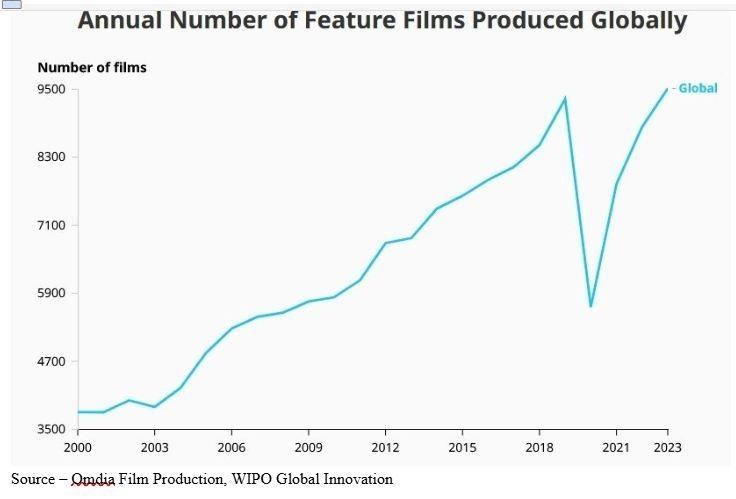
It’s estimated that more than 10,000 films were produced/released around the globe. That’s compared to the last official count in 2023 – 9,511 – and 5,656 in 2020.
Do you see the problems emerging?

Golden Era – The Tecart Studios poster celebrates the golden era of filmmaking when Hollywood was the center of the creative universe
Much as we like to kid ourselves, Hollywood is not the center of the video content universe.
It’s just one of hundreds of great movie creation locations spread around the world.
Second, the crushing fact is that even if we did nothing but sit in front of our big screen all the time, we couldn’t keep up with the growing video content supply.
Okay, the pandemic forced content production films/shows to drop a crushing 40 percent back in 2020. Then, in 2023, the dual film strikes put the brakes on production in the US. A number of other countries (primarily Canada and Britian) felt the ripple effect because studios/streamers were producing so much of their stuff over there.
But the ROW?
They hardly felt the tremor because they were busy doing their stuff.
In fact, both events helped them all, even China.
Yes, the box office in the People’s Republic dipped by 24 percent in 2024; but that was driven primarily by a slowing domestic economic growth which also affected entertainment spending.
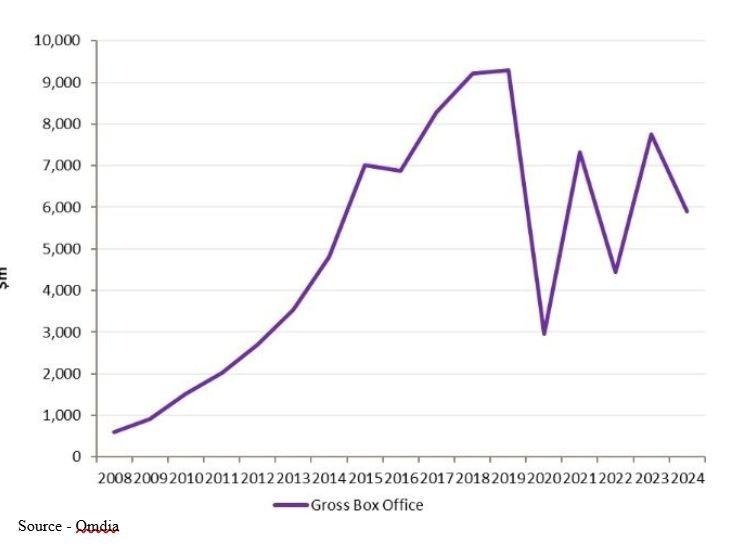
China’s Film Growth – China’s government has focused time and money to ensure the depth and breadth of the country’s video content quality continues to improve to entertain the population.
And while the country’s film industry goes through severe swings of feast/famine, it has continually improved its quality and quantity.
Local films accounted for more than 80 percent of the theatrical content folks saw there, thanks to a series of very solid productions.
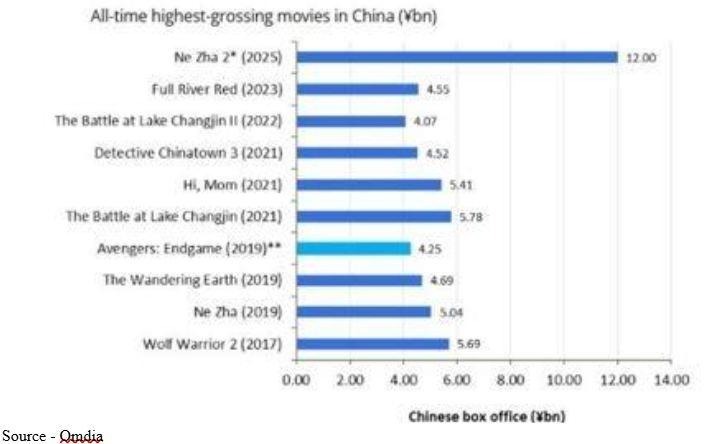
First Rate – Chinese studios/creatives have made tremendous strides in producing films and video stories people everywhere want to see, enjoy.
The animated blockbuster Ne Zha 2 swept the country and ultimately, the world.
Thanks to China’s government promoting locally produced films with millions of yuan and their versions of historical dramas like The Battle of Lake Changjin and most recently Dead to Rights, the industry seems to have finally gained solid footing.
In addition, the country’s film industry has been increasing its overseas distribution with a wider range of films. But they – like the rest of the industry – are meeting challenges.
Studios are struggling to recoup their costs on big-budget projects and people (everywhere) are cautious about spending on entertainment because of the slowing economy.
In addition, the film industry is competing for viewer time with other entertainment forms – streaming series, video games, the rise of AI-generated content and short videos.
It’s a common theme/challenge facing content producers – films/shows – around the globe.
Despite the ups and downs of the industry, India remains the leading content producer.
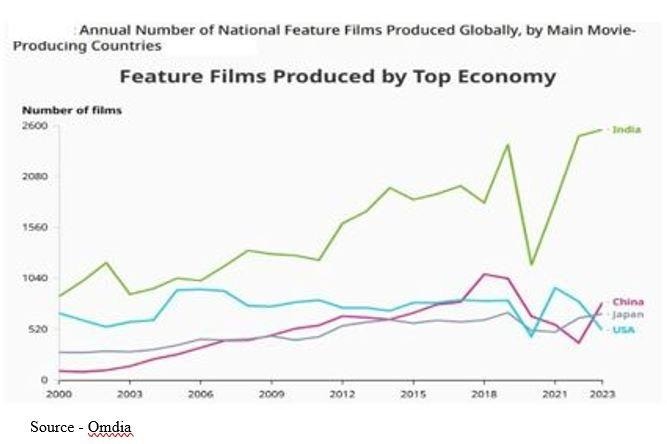
Significant Output – India’s film production centers – Mumbai, Hyderabad, Chennai, Kochi, and Kolkata – are constantly turning out films of every genre to meet the entertainment needs of the country’s 1.4B people as well as countries in the region and around the world.
Based on the latest official counting (2023), India was the leading global content producer with more than 2,500 movies and an even larger number of shows/series.
For the first time in the industry’s history, China ranked number two in film production, overtaking both Japan and the US.
While Japanese film and content creators have experienced phenomenal global success with projects for the leading streaming services, they continued to produce a steady stream of films – 676.
This moved the US film production industry down to the fourth position with 510 films. Spain continued its third year in a row as number five in global production and the leading EU film industry.

And thanks to the rapid production of state-of-the-art facilities around the world and new economic, easier-to-use creation, production and post tools as well as government and industry support to train people, film/show production and delivery is now a global activity.
Today, nine middle-income economies are in the top 20 global film/show production countries.
India, China, Mexico, Argentina, Brazil, Türkiye, the Philippines, Iran and Indonesia have made significant progress in improving their quantity and quality of creative content work.
Other top producers include Iceland, Estonia, Switzerland, Latvia, Croatia, and even emerging economies like The Dominican Republic and North Macedonia have become major sources of new, interesting content for the content hungry global streaming services.
All of this is good news and bad news for the content creation/production industry, especially in the US since they want your business and the companies and governments aren’t afraid to offer very tempting incentives…financial, equipment, production/support staffs, other.
In addition to tempting carrots, countries also wield a stick.
For streaming services to offer their content to locals, they also have to produce 30-40 percent of their video projects locally.

Yeah, they want their cut of the content – 30-40 percent – to be homegrown.
That initially seemed to be a barrier for the leading streaming services which were formed in the Americas where they drew most of their subscribers.
It’s estimated that 96 percent of North American households – 260M plus – have access to at least one streaming service with the average US household having four services – subscription, ad-supported, free).
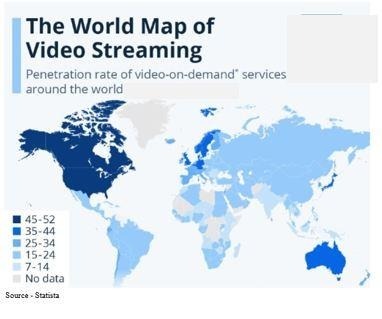
Saturated – The streaming services have captured at least 80 percent of the viewing population in the Americas so growth has to come from other points of the globe which also means they need to greenlight, acquire more local creative work for viewers … everywhere.
Yes, the service with the highest number of streaming users is YouTube but we continue to have difficulty calling it a streaming service since most of their users are attracted for the free short video content – creators’ 30 sec – 10 min shorts. However, they do have more than 495M users in India and about 255M in the US.
But the US/Canada account for the largest portion of Netflix subscribers as well as subscribers Prime, Disney +, Paramount, HBO (or whomever they belong to today) and Peacock.
Apple TV has an Americas penetration of about 50 percent with growing engagement in the UK, Brazil, EMEA and Australia.
Still, if the streaming services are to continue to grow, they have to increase their subscription numbers in other countries.

It turns out the creatives in all of the countries had been doing a lot of heavy lifting. They were more than carry and deliver the movie/show load that the streamers needed to meet the entertainment needs of the specific country but also regionally and BAM, they found that there really is such a thing as entertainment without borders.
Subscribers in North America quickly became hooked on shows/movies from South Korea, Japan, Spain, India, Brazil, Central/South America … heck everywhere.
K-content surged with Netflix success with Squid Games and hasn’t slowed since with Netflix, Amazon and the other services greenlighting/acquiring projects as quickly as possible.
Then Japan’s anime was “discovered” by viewers in the Americas and the country introduced a broad range of genre to the audiences.
Spanish content rose to the second largest content provided to the audiences and suddenly international content was everywhere.
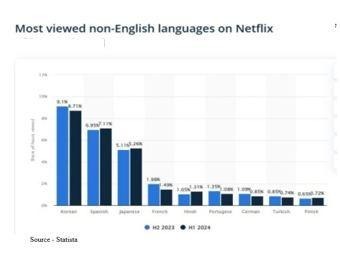
Global Video Stories – Streaming has increased the number of films/shows of all types and from everywhere beyond those created in English and they are finding the video stories interesting and entertaining.
Non-English content – shows/films – have become standard sought-after fare by English speaking home audiences.
Initially, local content was offered with subtitles which Bong Joon-ho, Oscar winner and director of Parasites said, “Once you overcome the one-inch-tall barrier of subtitles, you will be introduced to so many more amazing films.”
That was/is okay with us because we like to get the full experience of a show/movie the way it was originally produced and follow the verbal content in English.
We won’t claim that it has made us fluent in a wide range of languages; but after a period of viewing the project, we find it surprising and rewarding to be able to recognize certain words before we read them in the subtitles.
Of course, tremendous advances in AI localization tools have enabled streamers and content owners to automate, accelerate and lower the cost of adapting content from different cultures, languages and regions.
And increasingly streamers are going the extra mile by dubbing films/shows with nearly perfect voice and lip sync for those people who can’t get past Joon-ho’s “one-inch barrier.”
We appreciate the effort but somehow the richness of the storyline seems to disappear but then, that’s just us.
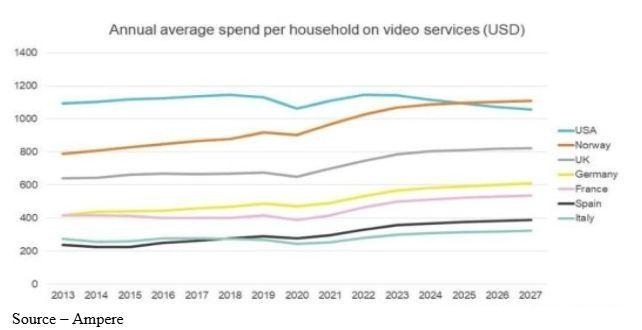
Ignoring Borders – Global streaming services have enabled people in any country to enjoy films/shows from around the globe and interest/subscriptions continue to grow.
But the wide-ranging global content production continues to drive the streaming services to provide some of the best and richest choices of content from the best content writers, producers, directors, actors, camera persons, production and postproduction teams the industry has at its disposal.
And consumers are continuing to respond.
This year, there is about a 20 percent penetration of the video streaming market, which is expected to reach 1.8B by 2030.
There’s plenty of headroom for growth in the streaming market, which easily translates into healthy growth in the content creation/production industry.
But as we said early on, it won’t be equal for all creatives in every country.
Creatives aren’t competing against the guys/gals in Hollywood or Atlanta.
They are pitting their storylines and ultimate productions against folks in the EU, EMEA, Central/South America, SEA and everywhere else in the four corners of the globe.
That can be a little overwhelming for everyone in the industry if they think about it too hard, but the key will always be being at their best in every phase of the film/show project and focus on what the viewer’s wants, needs and entertainment interests.

But there’s something magical that happens when the audiences (locally and globally) recognize great work.
It’s like nothing else people will experience.
And the great thing is you’ll be paid for using your creative talent to turn a lowly idea into a movie/show people will enjoy–not just where you live/work but nationally and internationally.
Rotten Tomato ratings or a cute little statue are nice but we’re talking about hundreds of thousands, even millions of folks saying “Damn that was a fantastic show/film.”
And frankly, that’s why we like streaming because we get to enjoy creative projects from around the globe in nearly every genre (sorry, but some mushy, ultra-frightening/gory content doesn’t appeal to us…but that’s us).
But as Kattappa said in Baahubali: The Beginning, “There’s still time for the 3rd shift watchers to join.”
Oh, and the projects we mentioned/alluded to in the beginning, we watched Baahubali (obviously) as well as Brazil’s The Outlaw (Bandida) and the French project Anelka: Misunderstood.
Of course, our friend had to one-up us by recommending a Macedonian indie post global pandemic film Beyond the Wasteland, with excellent acting by the main characters and unique twist (we’re told).
Then he tantalized us with a wacky British satire, The Extraordinary Adventures of Adele Blanc-Sec that he claimed to pick just at random but seriously it’s sorta difficult to go wrong with a good storyline built on top of Brit humor…sharp wit, ironic, self-deprecating, socially awkward and … funny.
Now all we have to do is put them at the top of the list of the 10,000 films content creators are delivering this year, which means “a few” will just pass into the unseen box.
Or you could watch, review them to give us more “free” time.
Andy Marken – andy@markencom.com – is an author of more than 900 articles on management, marketing, communications, industry trends in media & entertainment, consumer electronics, software and applications. He is an internationally recognized marketing/communications consultant with a broad range of technical and industry expertise especially in the storage, storage management and film/video production fields. He also has an extended range of relationships with business, industry trade press, online media, and industry analysts/consultants.