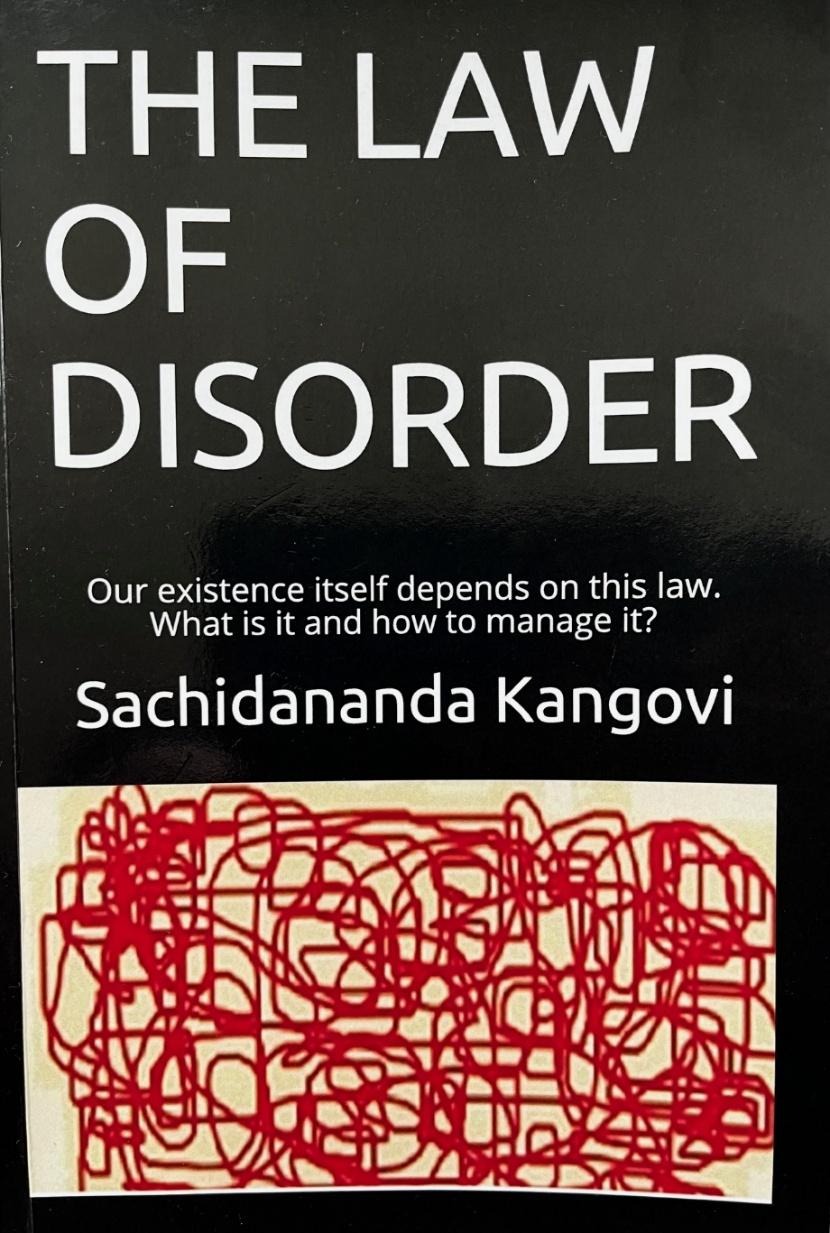
JERSEY CITY, NJ / ACCESS Newswire / December 27, 2025 / The Law of Disorder: Our Existence Itself Depends on This Law. What Is It and How to Manage It? authored by Dr. Sachidananda Kangovi, offers an engaging and interdisciplinary examination of the Second Law of Thermodynamics, also known as the Law of Disorder. Released in 2020, the book presents a broad exploration of how this scientific principle extends beyond physics to influence biological life, ecological systems, economic structures, governance, and modern information networks.
The work traces the historical development of the Second Law of Thermodynamics from Sadi Carnot’s early 19th-century studies of heat engines to contributions by William Thompson (Lord Kelvin) and Rudolf Clausius, who introduced the concept of entropy in 1865. Kangovi uses these foundations to discuss how increasing disorder underlies the structure of the universe, the arrow of time, climate systems, and living organisms. The book references scientific advances from figures such as Erwin Schrödinger, who proposed the application of entropy to life by stating that life has two components (a) Order from Order and (b) Order from Disorder. These components later led to discoveries in genetics by Crick, Watson and Wilkins and non-equilibrium thermodynamics by Ilya Prigogine, which showed that food and other resources that we need from our ecosystems for sustenance lead to disorder in our surroundings.
Beyond the natural sciences, the book surveys research that has identified entropy-like patterns in many non-biological systems. Drawing on studies by Nedjeljka Petric, Daron Acemoglu, James Robinson, and David Collins, Kangovi highlights how disorder emerges in weakened institutions, unsustainable fiscal regimes, and breakdowns in rule-based governance. The book also discusses challenges associated with modern information platforms, echoing concerns raised by writers such as Thomas Friedman about the blend of reliable and misleading content in global social networks.
Kangovi classifies systems affected by the Law of Disorder into three types; natural, hybrid, and man-made systems, based on time scales and the degree of human influence. Natural systems, such as the universe, evolve over millions or billions of years and remain largely outside human control. Hybrid systems, including ecosystems and biological life, span thousands to millions of years, where human actions can have limited but measurable effects. Man-made systems, such as economies, governance structures, and digital information networks, change more rapidly, over decades or centuries, and are strongly shaped by policy choices and technological design.
The book concludes with a set of measures intended to slow or counteract disorder in systems shaped by human activity. These include ecological conservation, reducing greenhouse gas emissions, updating outdated legal frameworks, strengthening institutions, and improving the governance of online information.
It is worth emphasizing the book’s central argument: that the Law of Disorder is not a remote scientific concept but a structural force that shapes every aspect of existence. Kangovi argues that ignoring this law whether in environmental management, economic planning, or technological development creates vulnerabilities that accumulate over time, ultimately accelerating systemic breakdowns.
Kangovi also notes that entropy in social and digital systems often manifests long before it becomes publicly visible, making early intervention essential to slow the march of disorder for our own survival and for the survival of future generations. We must not add fuel to fire and increase the pace of growth of disorder by our follies.
The book underscores the importance of interdisciplinary thinking, urging policymakers, scientists, and civic leaders to collaborate across fields to design systems resilient to disorder. It further encourages readers to understand entropy as a tool for diagnosis rather than a prediction of collapse, suggesting that awareness of disorder can guide more adaptive and sustainable decision-making. By integrating scientific theory with governance, economics, and environmental policy, Kangovi positions the Law of Disorder as a unifying framework for understanding the challenges of the 21st century.
About the Author
Dr. Sachidananda Kangovi is an aerospace engineer, information technology executive, and author whose work spans engineering, systems analysis, and interdisciplinary scholarship. His professional background is available on his publicly accessible biography page.
CONTACT DETAILS:
Name: Sachidananda Kangovi
Email: sachk2003@gmail.com
SOURCE: The Law of Disorder
View the original press release on ACCESS Newswire
CHARLOTTE, NC / ACCESS Newswire / April 11, 2026 / Rosensteel Fleishman announced the release…
SYDNEY, AU / ACCESS Newswire / April 11, 2026 / Damien Singh is reflecting on…
NOT FOR DISTRIBUTION TO U.S. NEWSWIRE SERVICES OR FOR DISSEMINATION IN THE UNITED STATES. VANCOUVER,…
THIS NEWS RELEASE IS NOT FOR DISTRIBUTION TO U.S. NEWSWIRE SERVICES FOR DISSEMINATION IN THE…
UNIONDALE, NY / ACCESS Newswire / April 10, 2026 / Marquis Who's Who honors Zachary…
VANCOUVER, BC / ACCESS Newswire / April 10, 2026 / Trans Canada Gold Corp. (TSXV:TTG)(OTCQB:TTGXF)…