DEEP Robotics Expands Quadruped and Wheeled-Legged Robot Deployments Across Firefighting and Emergency Response
SINGAPORE, SG / ACCESS Newswire / August 16, 2026 / Firefighting and emergency response often require teams to enter environments that are difficult to assess in advance. Building fires, chemical leaks, collapsed structures, and flooded tunnels can put responders into conditions where visibility is poor, air quality is unknown, and structural integrity cannot be confirmed from the outside. DEEP Robotics, a developer of industrial quadruped robots and embodied AI systems, has been expanding its emergency and firefighting solutions to help rescue teams collect on-site information before people are committed to a scene.
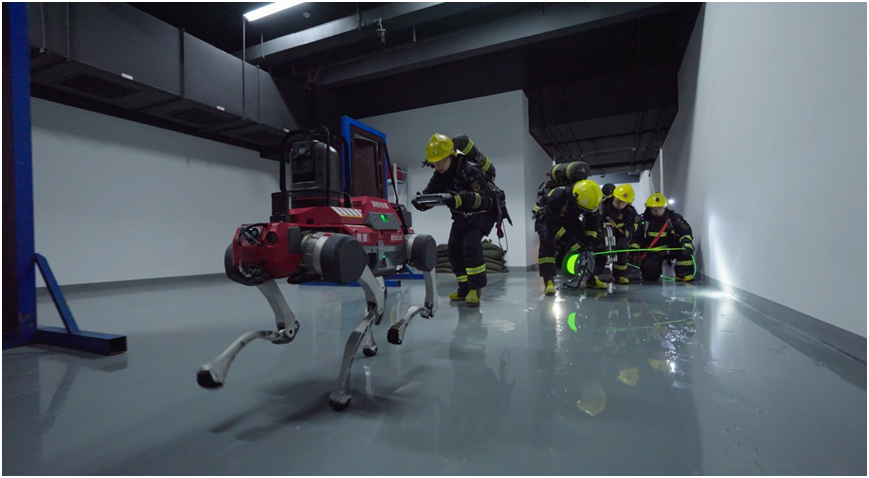
The company’s approach centers on its X30 quadruped robot and Lynx M20 wheeled-legged platform, deployed together as part of a reconnaissance-first workflow. Rather than replacing firefighters, the robots are positioned to enter hazardous areas ahead of personnel, transmit environmental data back to a command post, and support ongoing operations with communications relay and equipment transport once the initial assessment is complete.
How the System Works on Scene
In a typical deployment, reconnaissance units are the first to move in. The X30 carries a dual-spectrum camera and 3D LiDAR that let operators build a real-time map of the interior, identify likely fire sources, and track how the fire is spreading. Multi-gas sensors flag carbon monoxide, hydrogen cyanide, hydrogen sulfide, and hydrogen chloride as concentrations move into dangerous ranges – the kind of information that traditionally has to wait until a suited-up firefighter can take a reading.
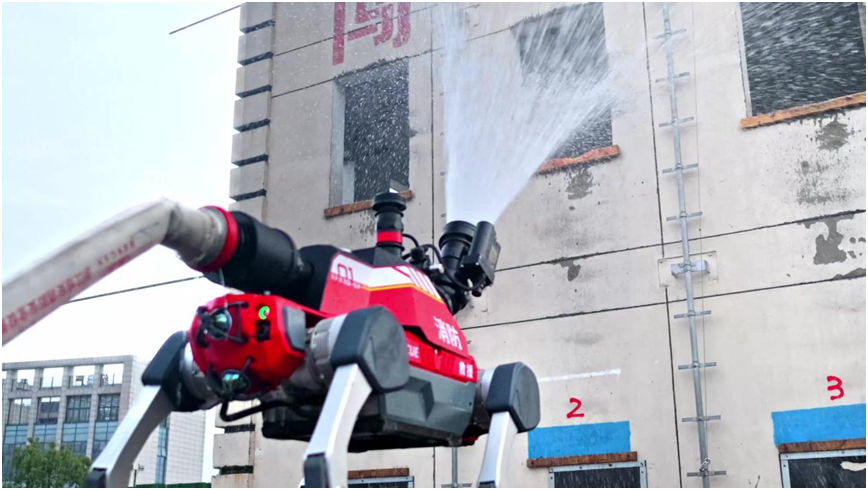
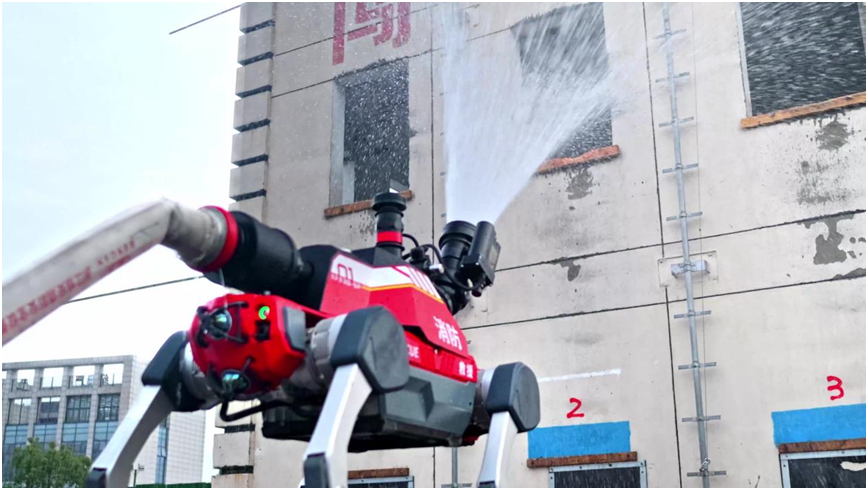
Communications robots follow to keep the network alive. When cellular coverage drops out inside a building, a tunnel, or a basement, the platform sets up a self-organizing mesh so the command feed does not go dark. Suppression and logistics units then move up. A water cannon payload supports both water and foam, with a range of up to 60 meters and a flow rate of 40 liters per second. Logistics units carry hoses, air tanks, and breaching tools forward, following personnel at up to 1.5 meters per second, which reduces the load firefighters have to haul on repeated trips in and out.
Field Validation

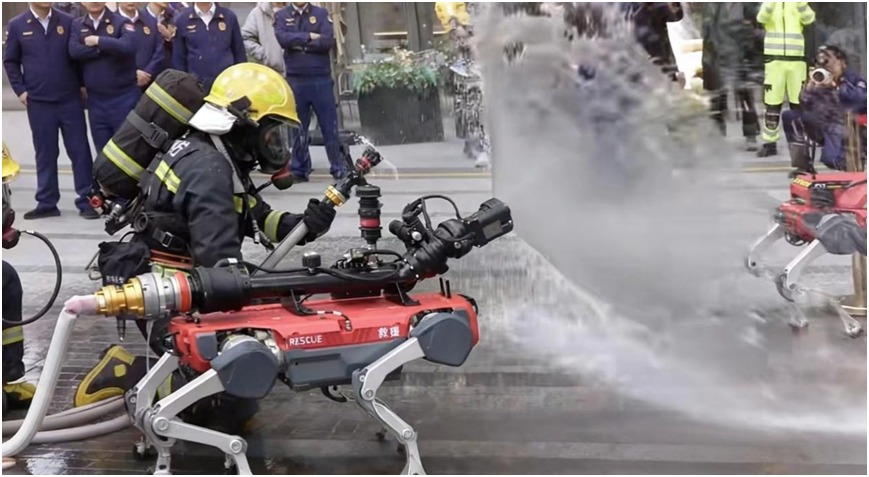
The X30 has been through several structured tests outside the lab. In the 2025 High-Rise Firefighting Drill, a multi-robot team combining reconnaissance, suppression, and logistics units carried out smoke-penetrating recon, victim search, hazardous-gas detection, and precision suppression inside a super high-rise scenario – the kind of environment where dense smoke, structural risk, and thin data typically push firefighter exposure to its limit. At the 2025 Emergency Response Competition, the same platform combinations took first and second place across tunnel and confined-fire tracks, working through signal blind spots with reconnaissance-plus-relay configurations.
The platform has also been tested in broader disaster scenarios. In the “Emergency Mission 2024” joint drill, the X30 was deployed alongside UAVs for hazardous-chemical explosion reconnaissance, using its dual-spectrum camera and gas sensors to provide temperature, radiation, and toxic-gas readings that fed into the responding brigade’s decision-making. Later exercises expanded that role to include victim search across simulated scaffold collapses, diesel tanker fires, and chemical leaks.
Why the Form Factor Matters
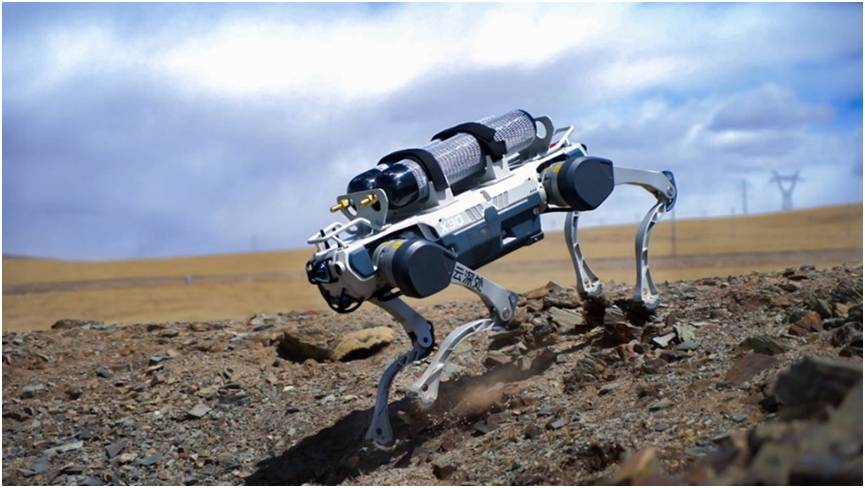
Firefighting robots on wheels or tracks have been available for years, but they need cleared paths and generally cannot handle stairs, debris fields, or the tight interior of a burning building. A quadruped chassis steps over obstacles that stop a wheeled unit, which matters when the fastest way into a scene is through rubble rather than around it. The X30 climbs slopes and stairs up to 45 degrees, clears obstacles up to 20 cm, and runs on an IP67-rated sealed body across a temperature range of -20°C to 55°C. That envelope covers most of the conditions a first-in team is likely to encounter on a fire ground.
The Lynx M20 adds a wheeled-legged option for scenes where speed on flatter ground matters – access roads, parking structures, industrial floors – while retaining the ability to switch to legged mode when the surface breaks up. Both platforms feed the same cloud command layer, which handles low-latency remote control, real-time mapping, AI recognition, and point-cloud visualization, and exposes standard API interfaces so existing incident-command tooling can consume the data.
A Broader Industrial Base
The same quadruped platform is already in commercial use outside emergency response. Singapore Power’s SP Group has deployed a customized X30, named “SPock,” to inspect underground power transmission tunnels – identifying cracks, water seepage, and other anomalies in sections that previously required manual patrol. According to DEEP Robotics, that deployment is expected to save roughly 480 hours of manual inspection time per year. Similar work is underway in power substations, cable tunnels, and mining operations. That commercial base is what makes the firefighting solution practical: it is not a purpose-built prototype but the same navigation stack, sensor payloads, and cloud platform that DEEP Robotics customers are already using for routine industrial inspection, retargeted at environments too dangerous for people.
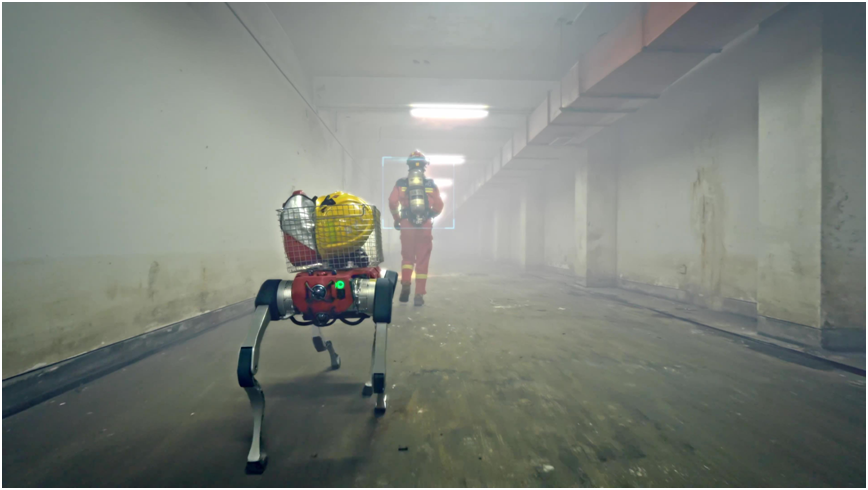
Emergency response has a straightforward test: does the equipment shorten the time between arriving on scene and understanding what is inside? For fire ground and hazardous-materials incidents, the argument for sending a robot in first is not about replacing firefighters – it is about giving them a clearer picture before they commit. DEEP Robotics’ quadruped and wheeled-legged fleet is being positioned around that job, and the results from recent drills suggest the platform is at the point where fire and rescue teams can treat it as an additional squad on the ground rather than a demonstration piece.
About DEEP Robotics
DEEP Robotics develops and manufactures quadruped robots, wheeled-legged robots, and the core components that go inside them. Its “Perception-Decision-Execution” technology framework supports deployments across energy, emergency response, industrial operations, and education. Coverage of the company’s work has appeared in Reuters, BBC, and Bloomberg, and its research has been featured on the cover of Science Robotics.
Company: DEEP Robotics
Contact: Vivian Chen
Email: chenlingjia@deeprobotics.cn
Website: https://www.deeprobotics.cn/en
SOURCE: DEEP Robotics
View the original press release on ACCESS Newswire